How to Clean a Bathroom: The Ultimate Step-by-Step Guide
SHARE:
Cleaning a bathroom the right way means working top to bottom, letting products dwell before scrubbing, and never skipping the surfaces that harbor the most bacteria. A thorough bathroom cleaning takes 20 to 45 minutes depending on size and soil level. This guide walks you through every step, the best products to use, and pro tips that make the job faster and the results last longer.
1. Gather Your Bathroom Cleaning Supplies Before You Start
Walking back to the cabinet three times mid-clean wastes more time than the cleaning itself. Before you touch a single surface, load a caddy with everything you need. Having the right bathroom cleaning supplies on hand is the difference between a 20-minute job and an all-afternoon ordeal.
Here is what to grab:
All-purpose disinfectant spray for counters, the toilet exterior, and light switches
Shower and tub cleaner designed to cut through soap scum
Glass cleaner for mirrors and any glass shower panels
Microfiber cloths (at least three: one for the toilet, one for other surfaces, one for mirrors)
A toilet brush with stiff bristles
Grout brush or old toothbrush for tile lines
Mop or damp Swiffer pad for floors
Rubber gloves
If you prefer safer, lower-VOC options, look for products that carry the EPA Safer Choice label, which certifies that every ingredient meets strict safety standards. The licensed and insured Arizona maids at Elite Maids House Cleaning use eco-friendly product options on every job, so you always have that choice.
2. Clear the Clutter and Ventilate the Room
Open a window or flip on the exhaust fan before you open a single bottle. Many bathroom cleaners contain chemicals that affect indoor air quality, and ventilation protects you. According to the EPA, volatile organic compounds in cleaning products can reach levels two to five times higher indoors than outside.
Then clear every surface. Pull shampoo bottles, soap dishes, and decor off the counter and out of the shower. Put trash cans outside the door. Shake out any rugs. Cleaning around objects is how grime hides for months. Clearing the space first means zero obstacles when you need to move fast.
3. Apply Cleaning Products and Let Them Dwell
This is the step most people skip, and it is exactly why their bathroom does not look clean even after scrubbing. Dwell time is the window a cleaner needs to actually break down soil and kill pathogens, and skipping it forces you to work harder with the brush.
Here is the correct order for applying your best bathroom cleaner products before any scrubbing begins:
Spray the toilet bowl cleaner inside the rim first so it can run down and soak.
Spray your shower and tub cleaner on walls, the floor of the tub, and any glass panels.
Spray the sink basin and let it sit.
Spray the toilet exterior, including the tank, seat, lid, and base, with disinfectant.
Set a timer for 5 to 10 minutes. Go make coffee. When you come back, those products have done half the work for you, making this the single biggest efficiency tip in any step-by-step bathroom cleaning process.
4. How to Clean a Toilet Step by Step
The toilet is where most people focus their energy, but they often clean it in the wrong order. Here is the correct toilet cleaning process from top to bottom:
Flush to wet the bowl. If there is standing water above normal, the cleaner you applied will dilute. A quick flush first gives you a clean wet surface.
Scrub the bowl. Use a stiff toilet brush to scrub under the rim, around the waterline, and down to the drain hole. Pay special attention to the underside of the rim, where bacteria accumulate in the splash zone.
Flush again to rinse.
Wipe the exterior. Work top to bottom: tank lid, tank sides, handle, toilet seat (top and underside), toilet lid (top and underside), bowl exterior, and finally the base near the floor. Use a separate microfiber cloth from the one you use on sinks.
Do not forget the hinges. The bolts where the seat attaches to the bowl collect residue that many people miss entirely. A cotton swab or old toothbrush gets into those crevices quickly.
For households with hard water, a toilet cleaner that contains citric acid or a mild acid formula dissolves mineral rings far better than scrubbing alone. Cleaning a toilet step by step in this sequence prevents cross-contamination from the dirtiest part (the bowl) to cleaner surfaces.
5. How to Clean a Shower and Bathtub
Soap scum, mildew, and hard water deposits are the three enemies of a clean shower. Each requires a slightly different approach, which is why a single spray-and-rinse method rarely works on a shower that has not been deep cleaned recently.
For soap scum: The shower cleaner you applied during the dwell step should have loosened most of it. Scrub with a non-scratch pad or a stiff brush. For textured tub floors, a grout brush gets into the ridges. Rinse thoroughly.
For mildew on grout and caulk: A paste of baking soda and water applied with a grout brush, left for a few minutes, then scrubbed, removes surface mildew. For persistent mold, a diluted bleach solution (one part bleach to ten parts water) works well on white grout, but test on a hidden spot first. The CDC notes that mold in bathrooms can affect respiratory health, so addressing it promptly matters beyond just appearance.
For glass shower doors: After the initial cleaner rinse, spray with glass cleaner and wipe with a dry microfiber cloth using horizontal strokes on one side and vertical strokes on the other. That way you can immediately tell which side still has streaks.
For shower heads: Fill a plastic bag with white vinegar, tie it around the shower head so the head is submerged, and leave it for 30 minutes to an hour. Remove, run hot water for 30 seconds, and the mineral buildup flushes right out.
If you book a professional bathroom disinfection service, technicians handle mold spots, grout cleaning, and hard water deposits that routine scrubbing cannot fully address.
6. How to Clean a Bathroom Sink and Vanity
Bathroom sinks see toothpaste, makeup, hair product, and soap every single day, and most of that residue builds up on the faucet hardware and around the drain faster than anywhere else on the vanity.
Sink basin: By now your cleaner has been dwelling. Scrub with a microfiber cloth or non-scratch sponge, paying attention to the overflow drain (the small hole near the top of the basin) and the rim around the drain. Rinse thoroughly.
Faucet and handles: Toothpaste splatters and hard water deposits cling to faucet bases. A small amount of all-purpose cleaner on an old toothbrush scrubs around the base of the faucet handles in seconds. Dry with a cloth immediately to prevent water spots from reforming.
Drain: If water is draining slowly, remove the drain stopper (most lift straight out or unscrew) and clean the hair and soap buildup off it. A hair-catching drain cover is a small investment that prevents slow drains from becoming a plumbing call.
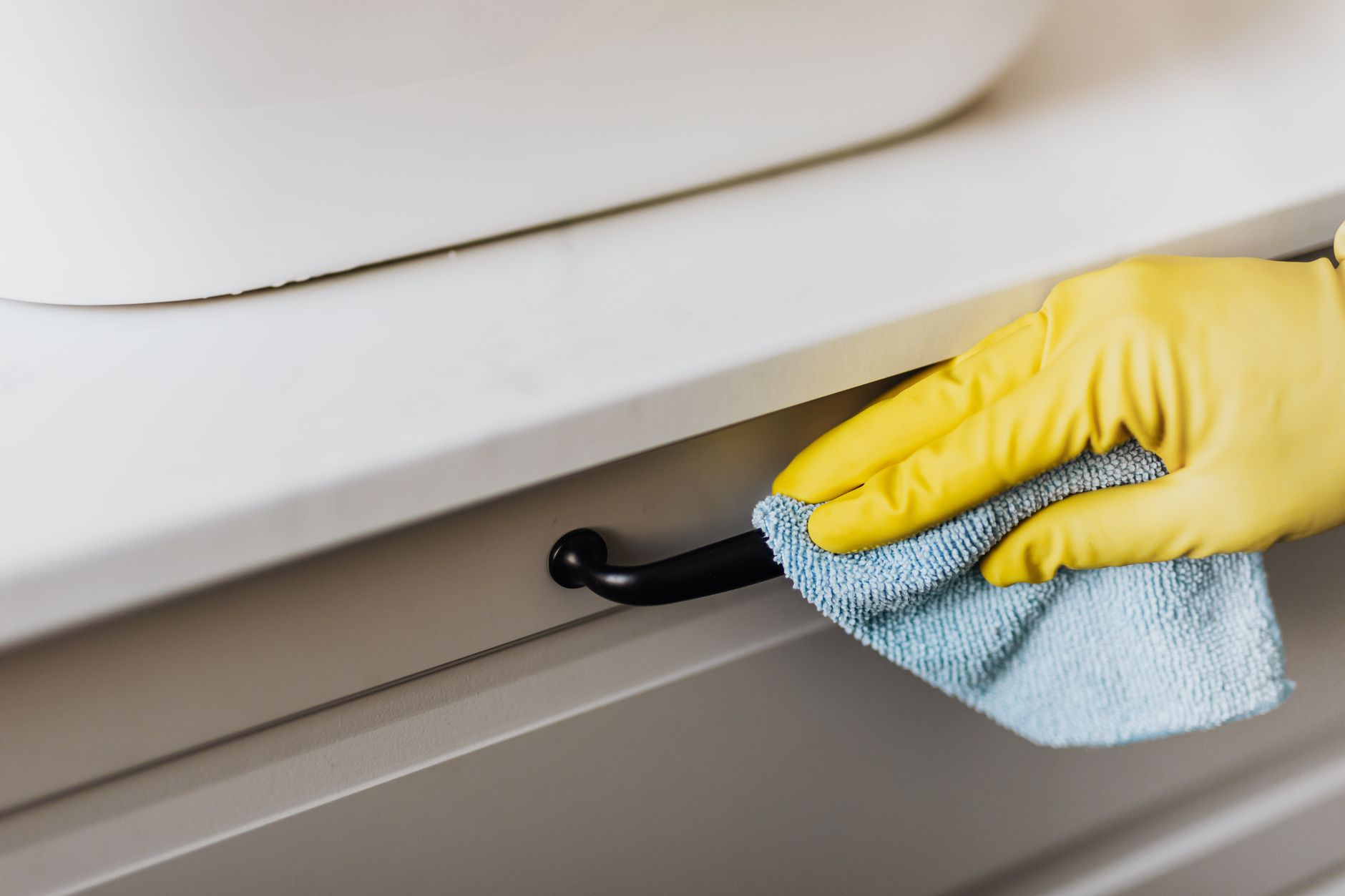
Vanity countertop and cabinet fronts: Wipe all countertop surfaces with disinfectant, then dry. Wipe down the exterior of cabinet doors and drawers with a damp cloth. Toothpaste splatters on mirror-level cabinet fronts are more common than people notice.
7. Clean the Bathroom Mirror and Fixtures
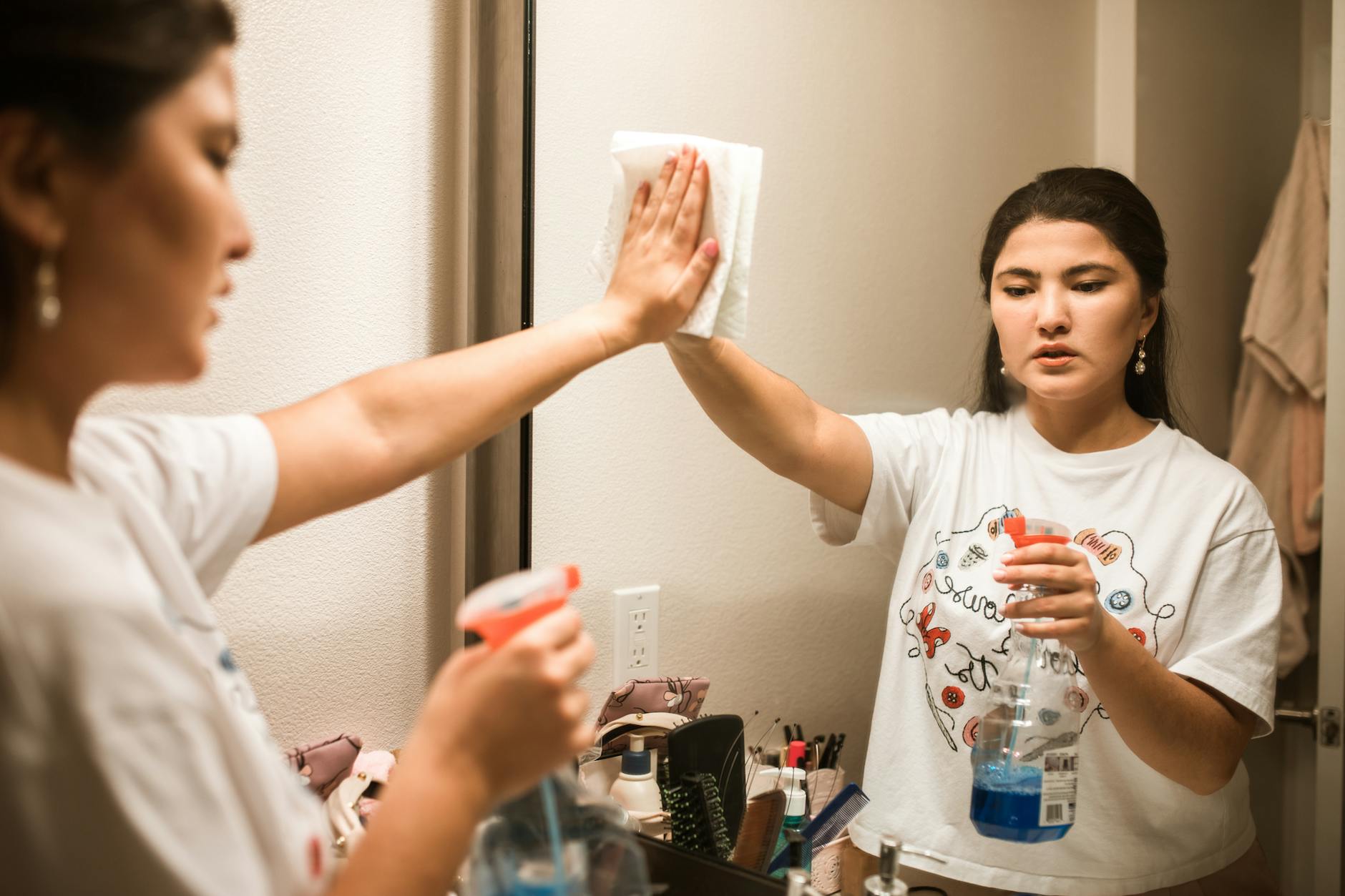
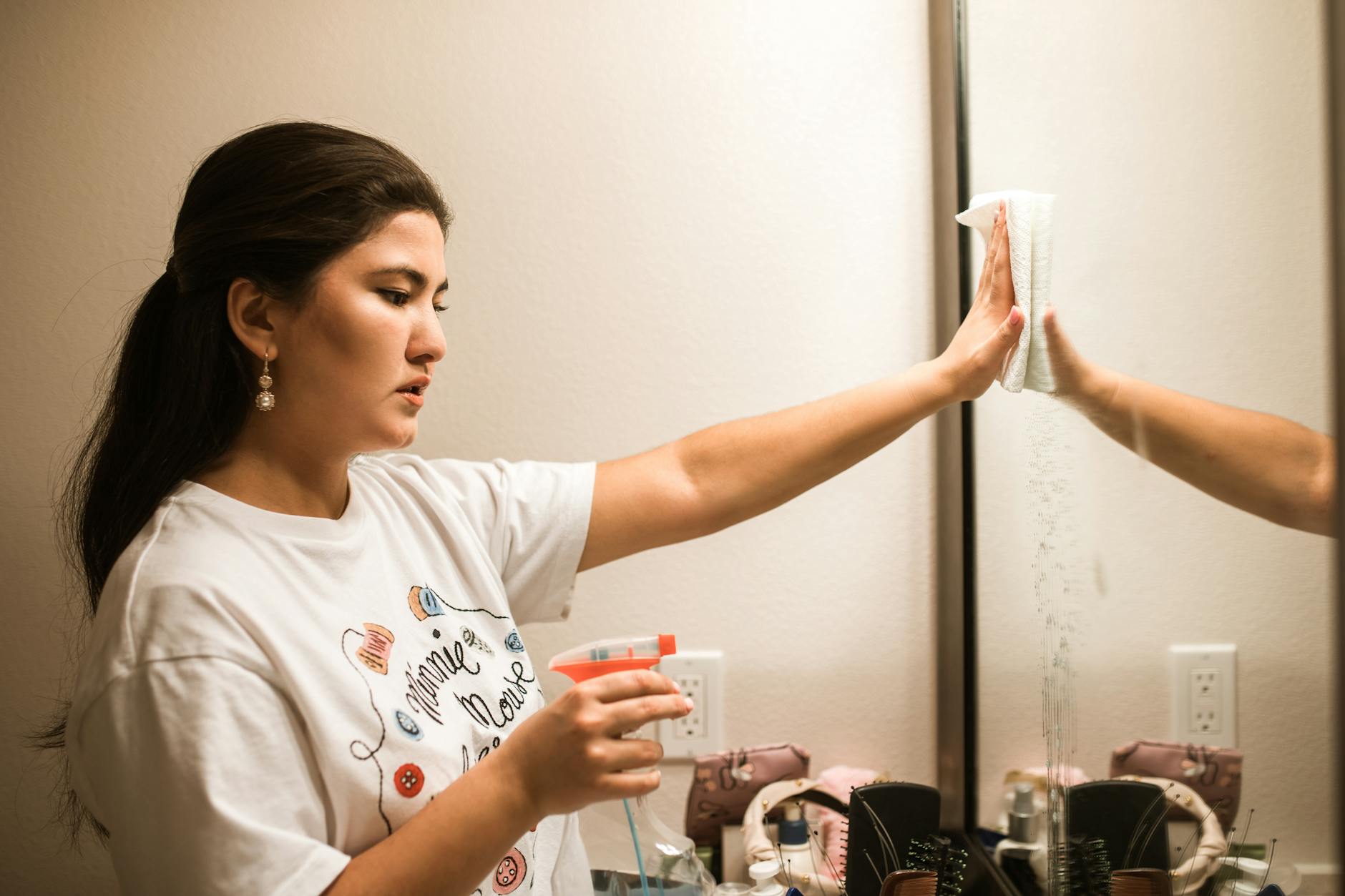
Mirrors are cleaned last among vertical surfaces so that any spray mist from the toilet or shower cleaner has settled. Spray glass cleaner directly onto a dry microfiber cloth rather than onto the mirror, which prevents overspray from landing on freshly cleaned surfaces around it.
Wipe in an S-pattern from top to bottom. Check from a side angle under the light to catch any spots you missed. Streak-free mirrors make the entire bathroom look cleaner at a glance, even if nothing else has changed.
While you are at eye level, wipe light switch plates, towel bars, toilet paper holders, and door handles with a disinfectant cloth. These are among the most-touched surfaces in any bathroom and are almost always skipped during routine cleaning. The cleaning editors at Good Housekeeping consistently point out that high-touch hardware is where cross-contamination happens most.
8. How to Deep Clean Bathroom Floors and Baseboards
Bathroom floors collect hair, product residue, and dust at a rate that surprises most homeowners. The correct deep clean bathroom floor sequence: sweep or vacuum first, then mop. Mopping without sweeping first just spreads wet hair and debris around.
For tile floors, use a cleaner appropriate for your grout type. Sealed grout can handle most all-purpose cleaners. Unsealed grout is more porous and benefits from a pH-neutral cleaner to avoid discoloration. Scrub grout lines with a stiff brush on a regular deep clean schedule, not just when they look visibly dark.
Baseboards in bathrooms get overlooked almost universally. Wipe them with a damp microfiber cloth, then dry. Hair and dust cling to the textured paint surface, and over time that buildup becomes obvious.
Allow the floor to dry completely before putting rugs back. Wet rugs on a damp floor create exactly the moisture conditions that encourage mold and mildew between cleanings.
If keeping up with a full bathroom deep clean feels like too much on top of a busy week, booking a professional cleaning online takes less than two minutes and gets a vetted cleaner to your door as soon as the same day.
9. Your Bathroom Cleaning Checklist at a Glance
Use this bathroom cleaning checklist to make sure nothing gets missed. Print it, screenshot it, or just run through it mentally before you put the supplies away.
Ventilation on before you start
Surfaces cleared and trash removed
All cleaners applied and allowed to dwell
Toilet bowl scrubbed and flushed clean
Toilet exterior wiped top to bottom (separate cloth)
Toilet seat hinges cleaned
Shower walls, floor, and door scrubbed and rinsed
Shower head descaled if needed
Grout lines scrubbed
Sink basin and overflow drain cleaned
Faucet and handles scrubbed and dried
Drain cleared of buildup
Vanity countertop wiped and disinfected
Mirror cleaned streak-free
Light switches, towel bars, and door handles disinfected
Floor swept or vacuumed, then mopped
Baseboards wiped
Rugs returned only after floor is dry
Running through a how-to-clean-a-bathroom checklist like this takes the guesswork out of the process and keeps every visit consistent, whether you are doing it yourself or preparing a bathroom before guests arrive.
10. How Often to Clean a Bathroom and Maintain Results Between Cleans
A full bathroom cleaning top to bottom should happen at minimum every two weeks for a household of two or more people. High-traffic bathrooms used daily by multiple people benefit from a weekly clean. Between those sessions, a few two-minute habits keep buildup from compounding:
Squeegee shower walls after every use. This single habit cuts soap scum buildup by roughly half.
Wipe the sink dry after brushing teeth. Water spots and toothpaste harden fast.
Spray the toilet bowl with a quick spritz of cleaner once mid-week and let it sit until the next flush.
Keep a microfiber cloth under the sink for fast mirror and counter wipes.
Run the exhaust fan for 15 to 20 minutes after every shower to reduce the moisture that feeds mold and mildew.
Consistent maintenance between professional or DIY deep cleans is what keeps a bathroom looking clean day to day without a major scrub session every week. Arizona’s most-reviewed house cleaning company offers recurring weekly, biweekly, and monthly service so these deep cleans happen on a schedule you can actually stick to.
Ready to Skip the Scrubbing? Contact Elite Maids House Cleaning
A clean bathroom is not just about appearances. It is about hygiene, comfort, and not spending your weekend with a grout brush. If you would rather hand this off to a professional team that is background-checked, bonded, and backed by a satisfaction guarantee, contact Elite Maids house cleaning today for a free quote. Serving Phoenix, Mesa, Scottsdale, Gilbert, Chandler, Glendale, Queen Creek, San Tan Valley, Tucson, and Flagstaff with same-day availability and instant online booking between 8am and 6pm.
Frequently Asked Questions
What is the best bathroom cleaner for 2026?
The best bathroom cleaner depends on what you are fighting. For general disinfection, a hydrogen-peroxide-based spray handles bacteria and viruses without harsh fumes. For soap scum in showers, a citrus-acid formula or a dedicated soap scum remover outperforms all-purpose sprays. For toilets, a gel cleaner with a thick consistency clings under the rim long enough to actually disinfect. Look for EPA Safer Choice-certified options if indoor air quality or kids are a concern.
How often should you deep clean a bathroom?
Most bathrooms need a full deep clean every one to two weeks, with light maintenance like wiping the sink and squeegeeing the shower done daily or every other day. Households with more people, pets, or heavy traffic should lean toward weekly. If a bathroom has visible mold, hard water buildup, or grout discoloration, a professional deep clean is the faster, more effective starting point before switching to a maintenance routine.
What order should you clean a bathroom in?
Always clean top to bottom and wet before dry. Apply bowl cleaner and shower spray first to maximize dwell time, then clean the mirror, wipe down shelves and the vanity, scrub the toilet exterior, scrub the sink, scrub the shower and tub, then finish with the floor. Cleaning in this sequence prevents dirty water and spray from dripping onto already-clean surfaces below.
How do you remove hard water stains from a bathroom?
White vinegar is the most accessible solution. Soak a cloth in undiluted white vinegar and lay it directly on the stain for 30 to 60 minutes, then scrub and rinse. For faucets, a vinegar-soaked paper towel wrapped around the base works well. Commercial limescale removers with citric or sulfamic acid work faster on heavy buildup. Avoid abrasive scrubbers on chrome or polished fixtures since they cause permanent scratching.
Can you clean a bathroom without bleach?
Yes, and many professionals prefer it. Hydrogen peroxide at a 3 percent concentration disinfects surfaces effectively without the fumes or fabric-bleaching risk of chlorine bleach. Enzyme-based cleaners break down organic matter like hair product residue and soap. For mold on grout, a commercial mold-specific spray that uses hydrogen peroxide or tea tree oil handles most surface mold. Proper ventilation and regular cleaning prevent most situations where bleach would feel necessary.
How to Deep Clean a Kitchen in 30 Minutes in Santa Fe
SHARE:
You can deep clean a kitchen in 30 minutes by working in a specific order: clear surfaces first, then spray everything down at once so cleaners do the soaking while you scrub elsewhere. This method removes grease, bacteria, and grime without wasted motion. The steps below walk you through the exact sequence Santa Fe homeowners use to get a spotless kitchen fast, whether you’re doing a quick reset before guests arrive or following a regular cleaning in Santa Fe routine.
1. Gather Your Supplies Before You Start the Clock
The biggest time-waster in any kitchen deep clean is hunting for supplies mid-task. Before you start the timer, pull everything out: an all-purpose spray, a degreaser, a microfiber cloth, a scrub sponge, baking soda, white vinegar, paper towels, and a trash bag. Having every tool within arm’s reach means you never break momentum.
If you prefer safer, low-VOC products, check the EPA Safer Choice program for certified cleaners that cut grease without harsh fumes. Santa Fe kitchens tend to accumulate cooking residue fast, especially in homes where southwestern flavors and high-heat cooking are part of daily life. Prep your kit, set a timer for 30 minutes, and start at the top of the kitchen and work your way down to the floor.
2. Declutter Countertops and Clear the Sink
Speed-cleaning a kitchen starts with removing visual and physical clutter. Pull everything off the counters, stack dishes in the sink, and throw away any trash or expired items. Do not stop to wash individual dishes yet. This decluttering step takes about two to three minutes but makes every other step faster because you have open surfaces to work with.
A clean kitchen starts with clear surfaces. Once the countertops are bare, you can spray the whole surface in one pass instead of navigating around appliances and mail piles. If you follow a structured cleaning schedule for your home, this declutter habit aligns perfectly with routines like the ones covered in our guide on keeping a clean house every week.
3. Spray Everything Down at Once (This Is the Secret)
The single biggest time-saving trick in a 30-minute kitchen deep clean is spraying all surfaces simultaneously so the cleaner does the work while you move on. Spray the stovetop, countertops, backsplash, sink basin, and the exterior of appliances all at once. Then walk away for two to three minutes and tackle something else.
This dwell time is where the real cleaning happens. Degreasers and all-purpose sprays need contact time to break down grease and stuck-on food. Skipping this step and wiping immediately is why most kitchen cleaning takes longer. According to Good Housekeeping’s cleaning guides, allowing a cleaner to sit for at least 60 seconds on greasy surfaces can cut scrubbing time in half.
4. Scrub the Stovetop and Oven Exterior
After the dwell time, come back to the stovetop first since it typically holds the most stubborn residue. Use your scrub sponge on the grates or burner rings, then wipe with a damp microfiber cloth. For baking soda paste on stuck-on spots, mix two tablespoons of baking soda with a small amount of dish soap and apply directly to the problem area. Let it sit for one minute, then scrub.
Wipe down the oven exterior, including the handle, control knobs, and the area around the burners. If your oven has a glass door with interior grime, that is a separate job for a full deep cleaning service rather than a 30-minute sprint. Focus the 30-minute kitchen deep clean on what guests and family members actually see and touch daily. The Santa Fe climate, dry and dusty for much of the year, means the top of the stove and surrounding surfaces collect a fine layer of particulate even between cooking sessions.
5. Wipe Countertops, Backsplash, and Cabinet Fronts
Now that the spray has done its job, wipe down all the flat surfaces with a clean microfiber cloth. Work in long, straight strokes rather than circles to avoid pushing grime around. Move from the back of the counter toward the edge, sweeping crumbs and residue off the surface as you go.
Pay attention to the backsplash near the stove where grease spatters collect. Wipe the fronts of cabinet doors at the most-touched spots, typically around handles and near the base of the upper cabinets. Cabinet fronts are often skipped during a quick kitchen cleaning, but they hold grease residue that builds up over time. If you want a room-by-room approach to thorough kitchen and home cleaning, the deep clean checklist for your home is a useful reference even for Santa Fe households.
6. Clean the Sink and Faucet
A gleaming sink pulls a whole kitchen together visually. Spray the basin with your all-purpose cleaner or a dab of dish soap and scrub in circular motions. Pay close attention to the drain area and the caulk line where the sink meets the counter, since mold and mildew can develop in those joints. The CDC notes that moisture-prone surfaces in kitchens and bathrooms are common sites for mold growth, making sink cleaning a genuine health task, not just an aesthetic one.
Wipe down the faucet handles and base with a damp cloth. Use an old toothbrush around the base of the faucet where soap scum and mineral deposits collect. In Santa Fe, where the water supply can have higher mineral content, calcium buildup on faucet hardware is especially common. A quick spray of white vinegar on these spots dissolves mineral deposits in about 60 seconds. Rinse with warm water, then dry the faucet with a cloth to prevent water spots.
7. Wipe the Refrigerator Exterior and Handle
The refrigerator exterior is one of the most-touched surfaces in any kitchen, which means it carries fingerprints, food splashes, and bacteria. Wipe down the entire front of the refrigerator with an all-purpose spray and microfiber cloth, focusing on the door handles and dispenser area if you have one.
Do not open the refrigerator for an interior clean during your 30-minute sprint. Interior refrigerator cleaning belongs in a more thorough session, like a one-time deep clean or periodic holiday cleaning before family gatherings. For the 30-minute kitchen deep clean, the exterior wipe-down is enough to keep the appliance looking maintained and prevent grime from transferring to your hands every time you reach for the handle.
8. Sweep and Mop the Floor to Finish Strong
Floors go last, always. Everything you scrub and wipe above the floor sends debris downward, so sweeping before wiping countertops means sweeping twice. Spend two to three minutes sweeping corners, under the toe-kick space below cabinets, and the area directly in front of the stove where crumbs concentrate.
Follow with a damp mop or a spray-and-wipe system for a hard floor. You do not need a full bucket-and-mop setup for a 30-minute kitchen deep clean. A flat mop head with a reusable microfiber pad cleans a standard kitchen floor in under four minutes. Indoor air quality improves when floor cleaning is consistent, since kitchen floors hold food particles and allergens that get stirred into the air. The American Lung Association recommends regular cleaning of high-traffic floors as part of a healthy indoor environment strategy.
9. Tackle Microwave and Small Appliance Exteriors
With your floors drying, use the final few minutes on the microwave interior and small appliance exteriors. For the microwave, place a bowl of water with a few tablespoons of white vinegar inside and microwave it for two minutes. The steam loosens splattered food so you can wipe the interior clean with a single swipe of a damp cloth. Wipe the exterior, button panel, and handle.
Wipe the exterior of your toaster, coffee maker, and any other small appliances sitting on the counter. These collect crumbs, oil mist, and dust that make a kitchen look dirtier than it is. A fast wipe with a lightly damp microfiber cloth takes 20 seconds per appliance. If you want deeper help with kitchen cleaning or a full professional clean for your Santa Fe home, professional cleaning services can cover every surface, including the spots a 30-minute session can’t reach.
10. When a 30-Minute Deep Clean Is Not Enough
A 30-minute kitchen deep clean is a powerful reset, but it is not a substitute for periodic professional cleaning. If your kitchen has not had a thorough clean in several weeks, if grease has built up behind the stove, or if cabinet interiors need attention, a proper disinfection service is the right call. This is especially true before major events, after a renovation, or when moving into a new home.
Elite Maids House Cleaning brings background-checked, insured, and five-star-rated cleaners to homes throughout the region. Every visit is backed by a reclean-at-no-cost satisfaction guarantee, so you never have to worry about a job left half done. If you want to extend the results of your 30-minute kitchen deep clean, a recurring maid service on a weekly or biweekly schedule keeps surfaces consistently clean so 30 minutes genuinely does the job every time. For more kitchen-specific techniques similar to what works in the high desert climate of Santa Fe, see our step-by-step post on kitchen deep cleaning in Flagstaff, which covers many of the same challenges. According to Real Simple’s cleaning advice, consistent maintenance cleaning between professional visits is the most effective strategy for keeping a kitchen genuinely clean, not just tidy.
If your kitchen needs more than a quick 30-minute reset, or if you would rather spend your weekend doing anything other than scrubbing, reach out to the team that Santa Fe homeowners trust. Contact Elite Maids House Cleaning in Santa Fe today for a free quote and get your kitchen, and your whole home, back to spotless without lifting a sponge.
Frequently Asked Questions
Can you really deep clean a kitchen in 30 minutes?
Yes, if you follow the right sequence. The key is spraying all surfaces at once so the cleaner does the work while you move to the next task. Working top-to-bottom and saving floors for last prevents double-cleaning. You will cover countertops, appliance exteriors, the sink, stovetop, and floors in about 30 minutes with focused effort and the right supplies ready before you start.
What is the best cleaner to use for a quick kitchen deep clean?
An all-purpose degreaser handles the majority of kitchen grime including stovetop residue, cabinet fronts, and countertops. For tough grease, a paste of baking soda and dish soap works without scratching. White vinegar in water is effective for mineral deposits on faucets and microwave interiors. For eco-conscious households, the EPA Safer Choice label identifies products that cut grease without harsh chemicals or strong fumes.
How do I deep clean a kitchen without chemicals?
White vinegar, baking soda, and dish soap handle most kitchen cleaning tasks without conventional chemicals. A baking soda paste scrubs the stovetop and sink. Vinegar dissolved in water cuts grease on appliance exteriors and glass surfaces. Steam cleaning with a microwave-safe bowl of hot water and vinegar loosens interior grime in minutes. These methods are effective, low-cost, and safe for households with children or pets.
How often should I deep clean my kitchen?
A light clean after every cooking session keeps surfaces manageable. A 30-minute deep clean of the kitchen once a week prevents grease and grime from building up to a point where scrubbing becomes necessary. A true professional-level deep clean, covering interior appliances, cabinet interiors, and behind-appliance spaces, is worth scheduling every one to three months depending on how heavily the kitchen is used.
What areas do most people forget during a kitchen deep clean?
The most commonly skipped areas are the backsplash above the stovetop, the top of the refrigerator, the area around the base of the faucet, cabinet door edges and handles, and the exterior of the range hood or vent. These surfaces collect grease and dust quickly but are easy to wipe down in under a minute each once you build them into your regular kitchen cleaning routine.
The Ultimate Deep Clean Checklist for Your Home in Queen Creek
SHARE:
A thorough deep clean checklist covers every surface, corner, and hidden area in your home that routine tidying misses. In Queen Creek, where desert dust and heat push grime into vents, grout lines, and appliance seals, a structured room-by-room approach is the only way to reset your home to truly clean. This post walks through every step, from the kitchen to the bedroom closet, so you know exactly what a professional-grade deep clean looks like.
1. What Is a Deep Clean and Why Queen Creek Homes Need One
A deep cleaning goes far beyond wiping counters and running a vacuum. It targets the buildup that accumulates over weeks or months: grease behind the stove, mineral deposits on faucets, dust layered on ceiling fan blades, and mildew creeping into tile grout. In Queen Creek, the combination of fine Arizona desert dust and intense heat means that dirt settles into every seam faster than it does in cooler, wetter climates. Pollen counts spike seasonally, and if your HVAC is circulating dusty air, that particulate lands on every shelf and upholstered surface in the house. According to the EPA’s indoor air quality guidance, indoor air can be two to five times more polluted than outdoor air, largely because of trapped dust, pet dander, and chemical residue from cleaning products. A thorough deep clean is one of the most direct ways to reduce that burden. For Queen Creek homeowners, scheduling a one-time deep clean at least twice a year, or before a move, after a renovation, or ahead of the holidays, is not optional maintenance. It is foundational to a healthy home.
2. Kitchen Deep Cleaning Checklist: The Hardest Room in the House
The kitchen earns its reputation as the most labor-intensive room on any deep clean house checklist. Grease aerosolizes every time you cook, and it settles on cabinet faces, the range hood interior, and the backsplash in layers you barely notice until they build up over months. Start your kitchen deep clean by pulling the refrigerator and stove away from the wall to clean behind and beneath them. Check the drip pans under burners, clean the oven interior using the self-clean cycle or a baking soda paste, and wipe down the inside of the microwave, including the ceiling and the turntable beneath the plate. Descale the coffee maker by running a cycle with white vinegar, then two rinse cycles of plain water. Wipe all cabinet faces and handles with a degreaser, clean the inside of cabinets and drawers, and discard expired pantry items. Scrub the sink basin and descale the faucet aerator by soaking it in white vinegar. Sanitize the garbage disposal by grinding ice cubes and salt, then flushing with lemon halves. For a full room-by-room kitchen strategy, our kitchen cleaning checklist breaks down every step in detail. The kitchen deep cleaning checklist should also include wiping the exhaust fan filter, cleaning the dishwasher door gasket, and scrubbing the grout between backsplash tiles. Do not skip the refrigerator coils; dusty coils make the unit work harder and cost more to run. According to Good Housekeeping’s cleaning guides, cleaning refrigerator coils annually can extend appliance life and reduce energy consumption noticeably.
3. Bathroom Deep Clean Checklist: Targeting Mold, Scale, and Hidden Grime
Bathrooms are where mold and mineral scale compete for territory, and both win if you let them. A proper bathroom deep cleaning checklist starts at the top: scrub the exhaust fan cover, which collects a surprising amount of lint and dust that then circulates through the room. Descale the showerhead by filling a plastic bag with white vinegar, securing it over the head with a rubber band, and letting it soak for at least an hour. Scrub the grout in the shower and on the floor tiles using a stiff brush; for stubborn mold, a paste of baking soda and hydrogen peroxide works without harsh fumes. The CDC notes that mold in homes can cause respiratory symptoms, especially in people with allergies or asthma, so treating it promptly during each deep clean is important. Clean the toilet inside the bowl, under the rim, around the base, and behind the tank. Wipe the entire vanity, including the inside of drawers and cabinets, and discard expired or unused personal care products, makeup, and medications. Polish mirrors, clean the light fixture covers, and scrub the floor and baseboard edges where soap residue and hair accumulate. Bathroom deep cleaning is also when you should caulk any cracked seams around the tub or shower base to prevent moisture from getting behind the wall. A complete deep cleaning house checklist treats the bathroom as a sanitation priority, not just a cosmetic one.
4. Bedroom Deep Cleaning Checklist: From the Mattress to the Closet
Most people underestimate how much a bedroom accumulates between deep cleans. A solid bedroom deep cleaning checklist starts with stripping the bed completely: wash the mattress cover, pillowcases, sheets, duvet cover, and the duvet or comforter itself if it fits your machine. Flip or rotate the mattress, then vacuum its surface using the upholstery attachment to remove dust mites and dead skin cells. Dust every surface from the ceiling down: fan blades, light fixtures, the tops of the headboard and wardrobe, window sills, and baseboards. Clean the inside of the closet, wiping shelves, reorganizing items, and vacuuming the closet floor. Wash or shake out any rugs in the room. Clean windows inside and out, including the tracks and frame, which gather a surprising amount of grit in Queen Creek’s dusty conditions. Wipe down all furniture surfaces and hardware, and vacuum upholstered pieces like chairs or benches. The American Lung Association recommends washing bedding in hot water regularly and vacuuming mattresses to reduce allergen exposure, a step that matters even more in a high-dust desert environment. Your bedroom deep cleaning checklist is also the right time to check under the bed: that zone is a magnet for dust bunnies, lost socks, and anything else that has rolled or slid out of sight over the months.
5. Living Room and Common Area Deep Clean: Upholstery, Vents, and Overlooked Spots
Living rooms and common areas tend to accumulate surface clutter, which tricks homeowners into thinking they are cleaner than they are. A deep cleaning apartment checklist or home checklist for these spaces should go well beneath the surface. Start by vacuuming all upholstered furniture, including beneath and behind cushions. Spot-clean any stains on fabric using an appropriate upholstery cleaner. Wipe down all hard surfaces: coffee tables, shelving units, entertainment centers, and decorative items. Dust blinds or clean curtains, which trap dust and allergens at every pleat. Clean the inside of any fireplace or clean around any gas insert; if you use a wood-burning fireplace, this is essential before heating season. Vacuum all air vents and returns throughout the house during this phase. The EPA’s mold resources remind homeowners that poor ventilation combined with dust buildup creates the conditions mold needs to establish itself. Clean baseboards, door frames, light switches, and wall plates, which are touched constantly but rarely wiped down. Vacuum and then mop hard floors, paying attention to edges and corners. For Queen Creek homes with tile throughout, grout cleaning in the common areas deserves its own dedicated effort. If you want a room-by-room template you can print or save, our checklist for deep cleaning every room gives you a ready-to-use breakdown. If you want to see how this checklist adapts to a specific home style, our deep cleaning checklist for Chandler bungalows shows how room size and layout affect the process.
6. Deep Cleaning for Appliances, Vents, and the Spots You Always Skip
Every deep clean house checklist has a section that most people skip because these tasks are not visually obvious until they are very overdue. In Queen Creek, desert air amplifies the need to stay on top of these areas. Washer and dryer: wipe the inside of the washer drum and clean the door gasket on front-loaders, where mold thrives in the folds. Clean the lint trap housing on the dryer by vacuuming out the slot behind the filter, and check that the dryer vent hose is clear. Dishwasher: remove and clean the filter basket at the bottom, wipe the door gasket, and run an empty cycle with a dishwasher cleaner or a cup of white vinegar on the top rack. HVAC vents: unscrew vent covers and wipe them down; vacuum the duct opening as far as your vacuum hose can reach. If you use a HEPA filter in your vacuum, this step genuinely captures fine particulate rather than redistributing it. Water heater area: wipe down the exterior and check for any corrosion or mineral buildup around the base. Garage entry and laundry room: these are dust and dirt traps that rarely get full attention. Wipe walls, clean the floor, and organize shelves. Consumer Reports consistently notes that appliance maintenance, including cleaning, significantly extends the lifespan of washers, dryers, and refrigerators. Treating these tasks as part of your professional deep cleaning checklist rather than an afterthought pays off in both air quality and appliance longevity. This is also when to schedule a holiday cleaning if your home hosts guests, since post-holiday grime compounds quickly if you let it sit.
Running through a deep clean house checklist on your own is absolutely doable. But there are situations where hiring a professional house cleaning service in Queen Creek saves you time, energy, and frustration. Move-in and move out cleaning in Queen Creek is the clearest example. When a lease ends or a home sale closes, the scope of what needs to happen, cleaning inside cabinets, appliances, closets, and every surface, goes far beyond what most homeowners can manage alongside packing and logistics. Post-renovation cleaning is another case: construction dust infiltrates every crevice, and without professional equipment, it recirculates for weeks. Seasonal deep cleans before summer or the holidays are a third scenario. Elite Maids maid service teams bring their own professional-grade supplies, use eco-friendly product options, and back every visit with a reclean-at-no-cost guarantee. Every cleaner is background-checked, bonded, and fully insured, which matters when you are letting someone into your home. For Queen Creek residents curious about pricing, you can check Cleaning in queen creek prices directly on the site and get an instant quote without picking up the phone. Elite Maids House Cleaning offers same-day scheduling between 8am and 6pm and serves Queen Creek as part of its broader coverage across Arizona’s Valley communities. Whether you want a one-time thorough cleaning or ongoing weekly or biweekly service, a professional team handles the scope, speed, and detail level that a solo effort rarely matches.
8. Building a Deep Clean Schedule That Actually Sticks
The biggest mistake homeowners make with a deep cleaning house checklist is treating it as a single event rather than a recurring system. The right cadence depends on your household. Homes with pets or young children need a full deep clean every two to three months. A two-person household with no pets can often stretch to every four to six months. Regardless of frequency, breaking the checklist into zones rather than attempting the entire home in one session makes the process far more manageable. Dedicate one weekend morning to the kitchen, another to bathrooms, another to bedrooms, and so on. A deep cleaning checklist template helps enormously here: print or save a version for each room and check off tasks as you go so nothing slips through. For a printed or downloadable version of the full checklist, our post on the ultimate deep clean checklist for your home gives you a complete template you can use immediately. If you live in an apartment or condo in Queen Creek, the scope differs slightly since you are working with less square footage and shared ventilation systems. Our apartment cleaning service handles those unique needs, including compliance with any move-out standards your landlord requires. Real Simple’s cleaning guides recommend tying deep clean tasks to seasonal anchors, like the start of fall and the end of winter, so they become a habit rather than an afterthought. The goal is a home that never gets so far behind that catching up feels impossible. And when it does start to feel overwhelming, that is exactly when a professional deep cleaning service in Queen Creek is worth every penny. Scheduling through our online booking page takes under two minutes and gives you an instant quote, so there is no excuse to put it off.
Ready to Deep Clean Your Queen Creek Home? Here Is How to Get Started
Whether you tackle the checklist yourself or hand it off to a professional team, the most important step is starting. Queen Creek homes deal with a unique combination of desert dust, heat, and seasonal allergens that make regular deep cleans more than a luxury. They protect your family’s health, preserve your home’s surfaces, and keep your space genuinely comfortable. If you are ready to skip the scrubbing and let professionals handle it, Cheapest cleaning in queen creek options are available on our site with instant online quotes. Contact Elite Maids house cleaning today for a free quote and find out why Queen Creek families trust us to give them their weekends back, visit after visit, with a satisfaction guarantee that means we are not done until you are happy.
Frequently Asked Questions
What is included in a deep clean for a house?
A deep clean for a house includes everything in a standard clean plus the areas that get skipped in regular maintenance: inside appliances, behind and beneath furniture, inside cabinets and drawers, grout scrubbing, descaling faucets and showerheads, cleaning vents and fan blades, washing baseboards, and sanitizing high-touch surfaces throughout. It is a top-to-bottom reset of the entire home rather than a surface-level refresh.
What should be included in a deep cleaning checklist?
A deep cleaning checklist should include room-specific tasks for the kitchen, bathrooms, bedrooms, living areas, and utility spaces. Kitchen tasks cover the oven interior, refrigerator coils, and cabinet faces. Bathrooms need grout scrubbing, showerhead descaling, and mold checks. Bedrooms include mattress vacuuming and closet cleaning. Common areas require vent cleaning, upholstery vacuuming, and baseboard wiping. Appliances and overlooked zones complete the list.
What is included in a deep clean of your home?
A deep clean of your home goes beyond surface cleaning to address hidden buildup, sanitation, and detail work throughout every room. This includes washing bedding, cleaning inside the refrigerator and oven, scrubbing tile grout, descaling plumbing fixtures, vacuuming mattresses and upholstery, cleaning light fixtures and fan blades, wiping all cabinet interiors, and disinfecting high-touch areas like door handles, light switches, and remote controls.
How often should Queen Creek homes be deep cleaned?
Most Queen Creek homes benefit from a professional deep clean every three to four months because of the region’s high dust levels and seasonal pollen. Households with pets, young children, or allergy sufferers may need deep cleaning every six to eight weeks. At minimum, scheduling a thorough deep clean twice a year keeps desert grime, mineral buildup, and indoor allergens from reaching levels that affect air quality and surface condition.
Is it worth hiring a professional deep cleaning service in Queen Creek?
For most homeowners, yes. A professional deep cleaning service brings commercial-grade equipment, trained techniques, and consistent checklists that cover areas a DIY approach often misses. In Queen Creek specifically, where desert dust and heat accelerate grime buildup, professionals deliver a more thorough result in less time. Backed by a satisfaction guarantee and eco-friendly product options, a professional team gives you a genuinely clean home without sacrificing your weekend.
Weekly House Cleaning Schedule for Busy Parents in Tempe
SHARE:
A weekly house cleaning schedule for busy parents in Tempe breaks household chores into small, manageable daily tasks so no single day becomes overwhelming. Spreading cleaning across the week means the kitchen, bathrooms, and living areas stay consistently tidy without eating up an entire Saturday. This guide walks you through a practical day-by-day routine, time-saving hacks, and when to call in professional backup.
1. Why Busy Parents in Tempe Need a Weekly Cleaning Routine
Life in Tempe moves fast. Between school pickups, work deadlines, sports practices, and everything in between, cleaning is usually the first thing that falls off the list. The problem is that skipping it for even a few days turns manageable clutter into a weekend-long project. A consistent weekly home cleaning routine solves that by turning big, dreaded cleaning sessions into short, repeatable habits.
Research from Real Simple consistently shows that people who follow a written cleaning schedule spend significantly less total time cleaning each week compared to those who tackle it all at once. For working moms and caregivers, that math matters. A structured house cleaning plan for parents is not about perfection. It is about keeping your home at a baseline level of clean that does not stress you out the moment you walk through the door.
If you are already searching for a recurring maid service to help carry the load, that is a smart move. But even when you have help, knowing what needs to be done each day keeps everyone on the same page.
2. How to Build Your Weekly House Cleaning Schedule: A Step-by-Step Guide
Before you assign tasks to specific days, take stock of your home. Count the rooms, note the high-traffic areas (usually the kitchen, main bathroom, and living room), and list every chore that needs to happen at least once a week. Then distribute those chores evenly so you spend no more than 15 to 20 minutes cleaning on any given weekday.
Here is a simple framework to follow when creating your weekly cleaning schedule for the whole family:
Audit your chores: List every task, from wiping counters to vacuuming floors.
Categorize by frequency: Separate daily tasks (dishes, wiping counters) from weekly tasks (mopping, scrubbing bathrooms) and monthly tasks (cleaning appliances, washing baseboards).
Match tasks to your energy level: Save heavier chores like mopping for a day when you have more time, like Friday or Saturday morning.
Write it down or print it out: A weekly house cleaning schedule printable posted on the fridge keeps the whole family accountable. You can also download a working mom cleaning schedule PDF from resources like Good Housekeeping and customize it to fit your home.
Build in a buffer day: Leave Sunday or one weekday as a catch-up day rather than scheduling new chores.
Once you have your framework, the daily breakdown below will give you a ready-to-use template you can start this week.
3. Monday: Kitchen Reset and Laundry Start
Mondays feel heavier when the kitchen is still carrying the mess from the weekend. That is why Monday is the right day to reset the kitchen completely. Wipe down all countertops and the stovetop, empty the dishwasher, take out the trash, and wipe the inside of the microwave. This takes about 15 minutes and immediately makes the home feel under control.
Also start a load of laundry on Monday morning before you leave for work or school drop-off. Running one load per day, rather than saving it all for the weekend, is one of the most effective cleaning tips for busy parents. By Friday, you will have worked through the whole family’s laundry without spending a single evening folding mountains of clothes.
The EPA’s guidance on indoor air quality notes that kitchens are a significant source of indoor pollutants from cooking, so regular wiping and ventilation matter more than most parents realize. Keeping kitchen surfaces clean is not just about appearances.
4. Tuesday: Bathroom Cleaning Day
Tuesday bathroom cleaning is a cornerstone of any effective weekly house cleaning schedule for busy parents. Assign Tuesday to scrubbing toilets, wiping down sinks and faucets, cleaning the mirror, and giving the tub or shower a quick spray and wipe. If you have multiple bathrooms, rotate a deeper clean on each one throughout the month rather than trying to deep-clean all of them every week.
Keep a small caddy under each bathroom sink stocked with a toilet brush, all-purpose cleaner, and microfiber cloths. When everything is right there, a bathroom wipe-down takes 10 minutes or less. That kind of low-barrier setup is what turns a cleaning routine for working parents into something that actually sticks.
If mold is a concern in your bathroom, the CDC’s guidance on mold in homes recommends keeping surfaces dry and improving ventilation. A quick squeegee after showers goes a long way toward preventing buildup between cleanings.
5. Wednesday: Living Areas and Dusting
Midweek is a good time to focus on the spaces your family uses most. Wednesday living room cleaning covers dusting surfaces, straightening pillows and throws, wiping down coffee tables, and quickly vacuuming the main living area rug or carpet. If you have kids, this is also a good day to do a toy sweep and return items to where they belong.
Dusting is a step many parents skip, but the American Lung Association points out that household dust contains allergens, dust mites, and particulate matter that can aggravate asthma and allergies, especially in children. Keeping dust off surfaces weekly, rather than monthly, makes a real difference in air quality for your family.
On Wednesdays, also wipe down any high-touch surfaces throughout the house: light switches, door handles, and remote controls. It takes under five minutes and is one of those small home cleaning habits that parents in Tempe who have school-age kids will appreciate most during cold and flu season.
6. Thursday: Floors and Quick Tidying
Thursday is floor day. Sweep or vacuum hard floors in the kitchen, hallway, and bathrooms. Mop any hard floors that need it. Spot-clean any visible carpet stains. Doing floors on Thursday means your home looks its best heading into the weekend, without requiring a full cleaning marathon on Saturday morning.
Thursday is also a good day to do a quick tidy of bedrooms: make beds if they have not been made, clear nightstands, and gather any laundry that has piled up. Bedroom tidying takes about 10 minutes per room and keeps the private spaces of your home feeling calm rather than chaotic.
For parents managing a home cleaning routine on a tight schedule, the trick is never aiming for perfection on any single day. Consistent, light effort beats infrequent deep cleaning every time. Internal links like our guide to cleaning tips for busy parents offer more ideas on keeping things manageable week to week.
7. Friday: Quick Wipe-Down and Weekend Prep
Friday is about light maintenance, not heavy lifting. Do a quick 10-minute wipe of kitchen counters, run a load of laundry if any remains, empty trash cans throughout the house, and do a general visual sweep of every room. The goal is to walk into the weekend without the nagging feeling that the house needs work.
For parents who work from home in Tempe, Friday afternoon is also a natural time to reset your workspace: clear the desk, file loose papers, and wipe down any shared surfaces. A clean workspace on Monday morning starts with five minutes on Friday.
If you are looking for even more structure, a free cleaning schedule for working moms is a great search to run. You will find printable templates that slot right into this day-by-day framework. You can also check out our post on time-saving cleaning hacks for busy moms for shortcuts that make Fridays even faster.
8. Saturday and Sunday: Rest, Catch-Up, and Deep Cleaning
Weekends should not be consumed by cleaning. If your weekday routine is working, Saturday and Sunday require very little. Saturday morning is a good time for any overflow chores that did not happen during the week, such as cleaning out the refrigerator, wiping down appliances, or doing a full bathroom scrub if it was only touched up midweek.
Sunday is best kept as a rest and reset day. Meal prep, family time, and light tidying rather than heavy scrubbing. If the whole family pitches in on a 20-minute Sunday reset (everyone picks up their own spaces), the home stays orderly without any one person carrying all the work.
Once a month, a Saturday morning is the right time to schedule a deep cleaning service through a professional team. Deep cleans cover the things your weekly home cleaning routine skips, such as scrubbing grout, cleaning inside the oven, washing baseboards, and wiping the inside of cabinets. Having a professional Elite Maids House Cleaning team handle the monthly deep clean means your weekday routine stays light because the heavy work is already covered.
9. Weekly vs. Monthly Upkeep: Knowing What to Clean When
One of the biggest sources of overwhelm for parents is not knowing which tasks are weekly versus monthly. Trying to do everything every week burns you out fast. Here is a simple breakdown to help you prioritize your home cleaning schedule:
Weekly tasks: Wipe kitchen counters and stovetop, clean bathrooms, vacuum or sweep floors, dust surfaces, wash one to two loads of laundry per day, take out trash.
Biweekly tasks: Mop all hard floors, wipe down cabinet fronts and appliance exteriors, clean mirrors throughout the house.
Monthly tasks: Clean inside the oven and microwave, wipe down baseboards, wash bedding and pillowcases, clean the inside of the refrigerator, vacuum furniture and under cushions.
Seasonal tasks: Wash windows, clean air vents and filters, declutter closets, clean behind large appliances.
This kind of tiered approach is what separates a working parent home cleaning plan that lasts from one that falls apart after two weeks. For a deeper look at how cleaning frequency affects results over time, our post comparing weekly, biweekly, and monthly house cleaning schedules breaks down the tradeoffs clearly.
10. Seasonal Cleaning Considerations for Tempe Homes
Tempe’s desert climate creates some cleaning priorities that parents in other regions do not face. Dust and fine particulate matter are more significant here than in wetter climates. The EPA’s Safer Choice program recommends using cleaning products that do not add chemical pollutants on top of the airborne particles already common in desert homes. Opting for fragrance-free, low-VOC cleaners is especially smart for households with young children or anyone with respiratory sensitivities.
Seasonal cleaning in Tempe also means paying attention to your HVAC filters. During Arizona’s dust season, replacing your air filter every month rather than every three months keeps indoor air cleaner and reduces the dust that settles on furniture and floors. Building a filter check into your monthly cleaning routine is a small habit with a big payoff.
Summer in Tempe also means windows stay closed longer, which increases the importance of indoor air quality habits. Opening windows on mild evenings when temperatures drop is a natural way to ventilate, and doing a thorough wipe-down of window sills and AC vents each season keeps allergens from recirculating.
11. When to Hire a Professional House Cleaning Service in Tempe
Even the most organized parents hit walls. If your weekly home cleaning routine is consistently falling behind, or if you are managing a newborn, a major work project, or any other season of life that leaves nothing in the tank, hiring a house cleaning service in Tempe is not a luxury. It is a practical decision.
Professional residential cleaning covers everything on your list and more, done faster and more thoroughly than most parents can manage on their own. For Tempe families, the options include weekly, biweekly, or monthly recurring visits so you can match the service frequency to your budget and your home’s actual needs.
You can also book a cleaning online with an instant quote, no phone call required. Same-day service is available between 8am and 6pm, so even a last-minute decision to get help before company arrives is easy to act on. For parents who have never used a cleaning service before, a great starting point is reading through tips like those in our guide to weekly house cleaning routines for busy parents to understand what a professional visit covers versus what your daily habits maintain.
Every cleaner on the Elite Maids team is background-checked, fully insured, and backed by a reclean-at-no-cost satisfaction guarantee. That means if anything is missed, the team comes back and makes it right at no charge to you.
If you are ready to stop spending your weekends cleaning and start spending them with your family, contact Elite Maids House Cleaning in Tempe today for a free quote. Getting started takes less than two minutes online, and your first clean could happen as soon as today.
Frequently Asked Questions
What should be on a weekly house cleaning schedule for busy parents?
A solid weekly house cleaning schedule for busy parents includes daily kitchen wipe-downs and dishes, Tuesday bathroom scrubbing, Wednesday dusting and living area tidying, Thursday floor vacuuming or mopping, and a quick Friday reset. Spreading chores across the week keeps any single day from taking more than 15 to 20 minutes, which is realistic even on the busiest days.
How do working moms keep their house clean without burning out?
The key is assigning one or two specific tasks to each day rather than trying to clean the whole house at once. A free cleaning schedule for working moms that is posted somewhere visible, like the fridge, helps build consistency. Recruiting kids for age-appropriate tasks and scheduling a professional cleaning service once or twice a month also takes significant pressure off one person.
How long should daily cleaning take for a busy parent?
On a well-structured weekday cleaning plan, daily tasks should take no more than 15 to 20 minutes. That includes wiping the kitchen, starting laundry, or doing a quick bathroom touch-up. Heavier tasks like mopping or scrubbing the full bathroom can take 30 minutes, but those only happen once a week per area, not daily.
Is weekly professional house cleaning worth it for families in Tempe?
For most families in Tempe with two working parents or young children, weekly recurring cleaning is one of the most impactful time-saving investments available. It keeps the home consistently clean without requiring parents to spend weekend hours on chores. Many families also opt for biweekly professional cleaning and maintain a lighter daily routine in between visits.
Where can I find a printable weekly cleaning schedule for parents?
You can find printable weekly house cleaning schedule templates through household resources like Good Housekeeping or Real Simple, or create your own using the day-by-day breakdown in this guide. Many parents also ask their cleaning service for a task checklist, which doubles as a customizable weekly cleaning schedule PDF they can pin up at home.
How to Deal with Cluttered Countertops in Queen Creek Homes
SHARE:
Dealing with cluttered countertops means clearing surfaces of items that do not belong, organizing what remains into logical zones, and building habits that keep the clutter from coming back. In Queen Creek homes, where open-concept kitchens and busy family schedules collide, countertop clutter is one of the most common complaints homeowners have. This guide walks through practical, step-by-step strategies to reclaim your surfaces and keep them clean for good.
If you live in Queen Creek, you already know how quickly a kitchen counter can go from spotless to completely buried. Between the mail, the kids’ school papers, the coffee maker, the air fryer, the vitamins, and the random items that land there because they have nowhere else to go, countertops take the brunt of daily life. The good news is that with a clear process, you can get those surfaces under control and actually keep them that way. Whether you are managing this on your own or you have been searching for cleaning queen creek arizona, this post covers both approaches so you can choose what works for your household.
1. Why Cluttered Countertops Are More Than Just an Eyesore
Cluttered countertops are not just a visual problem. When surfaces pile up with appliances, paperwork, and miscellaneous items, they create hidden hygiene issues that most homeowners overlook. Food crumbs and residue trapped under small appliances attract pests. Moisture from coffee makers or dish drying racks gets sealed under clutter and becomes a breeding ground for mold and mildew, which the EPA links to respiratory issues and allergic reactions.
Beyond health, countertop clutter makes cleaning harder. A professional cleaner cannot properly sanitize a surface that is buried under a dozen objects. The clutter prevents disinfectants from reaching the countertop material directly, which means bacteria and food residue linger even after a wipe-down. Messy countertops also raise stress levels. Research consistently shows that visual disorder increases mental fatigue and anxiety in household members, particularly in the kitchen where families spend so much time. In short, a cluttered countertop is a cleaning problem, a health problem, and a mental wellness problem all at once.
2. Do a Full Countertop Purge Before You Organize Anything
The single biggest mistake people make when trying to deal with cluttered countertops is organizing without purging first. You cannot create a clean, functional surface by rearranging clutter. You have to remove everything from the counter completely, set it on the kitchen table or floor, and then make deliberate decisions about what earns back its spot.
Go through every item using three categories: keep on the counter, store elsewhere, or donate and discard. An item earns a spot on the counter only if you use it every single day. The toaster? Probably stays. The bread maker you used twice in three years? It needs to go to a cabinet or a donation pile. The pile of mail and permission slips? Those need a dedicated home somewhere that is not the counter. Be ruthless here. Every item you allow back onto the surface is a commitment to working around it during cleaning. Once you have cleared everything, wipe the bare countertop down thoroughly before anything goes back. This is also a great moment to schedule a deep cleaning service if grime, grease, or staining has built up under the clutter over time.
3. Set Up Countertop Zones That Match How You Actually Cook
Once your countertops are clear, the next step is to organize what stays into intentional zones. Countertop zone organization is the practice of grouping items by function so that your counter works with your routine instead of against it. Think of it like a workstation: each zone has a purpose, and nothing lives in a zone unless it serves that purpose.
Common zones in a Queen Creek kitchen might include a coffee and beverage zone near the outlet closest to the refrigerator, a prep zone near the sink with a cutting board and knife block, and a small appliance zone for the toaster or microwave if it does not fit in a cabinet. The key to making zones work is strict boundaries. Items from the coffee zone do not migrate to the prep zone. When you finish using something, it goes back to its zone rather than landing wherever there is empty space. Zones also make countertop cleaning faster because a cleaner knows exactly what to move, wipe under, and replace in the right order. If you book recurring maid service with Elite Maids House Cleaning, your cleaner will work around your zones efficiently and consistently visit after visit.
4. Use Cabinet Space More Aggressively to Free Up Surfaces
Most Queen Creek homeowners are not using their cabinet space to its full potential. This leaves items sitting on the counter that could easily live somewhere else. Aggressive cabinet organization is one of the fastest ways to clear cluttered countertops without buying a single organizational product.
Start by pulling everything out of your upper and lower cabinets. You will almost certainly find items you forgot you owned, multiples of the same thing, and products that have expired. Consolidating and editing your cabinet contents typically frees up one or two full shelves, which is enough space to move most of the small appliances currently living on your counter. Vertical space is almost always underused. Adding a second shelf riser inside a cabinet can double the usable storage in that cabinet. Pull-out drawer organizers mounted inside lower cabinet doors give you bonus storage for cleaning supplies, plastic wrap, and foil so those boxes stop taking up counter real estate. When your cabinets actually work for your lifestyle, your countertops stop being a dumping ground because there is a clear home for everything.
5. Create a Command Station Somewhere Other Than the Kitchen Counter
One of the most persistent sources of kitchen counter clutter is paperwork: mail, school forms, bills, coupons, and lists. These items land on the counter because there is no better designated spot for them. The fix is to create a household command station in a different location, such as a hallway cabinet, a wall-mounted organizer in the laundry room, or a small desk area in the living space.
A command station does not have to be elaborate. It just needs a spot for incoming mail, a spot for outgoing mail, a small calendar or whiteboard, and a place to charge phones and devices. Moving device charging off the counter alone eliminates a tangle of cables and chargers that accumulates over time. For families in Queen Creek with school-aged kids, adding labeled folders or slots for each child’s papers makes a significant difference. When your command station is set up and everyone in the household knows to use it, the kitchen counter stops being the default landing zone for life’s administrative chaos. For more ideas on household organization and cleaning habits, resources like Good Housekeeping’s cleaning section offer reliable, tested guidance.
6. Adopt a Daily Countertop Reset Habit to Prevent Re-Cluttering
Clearing cluttered countertops is only half the work. The other half is staying consistent so they do not pile back up within a week. The most effective strategy is a daily countertop reset: a five-minute habit at the end of each day where you clear, wipe, and reset every surface to its baseline state.
A countertop reset is not a deep clean. It is a quick pass where everything gets returned to its zone or its home, crumbs get wiped up, and the surface gets a fast spray-and-wipe with an all-purpose cleaner. Done every night before bed, this habit prevents the slow accumulation that leads to clutter chaos. It also makes the kitchen genuinely welcoming every morning, which research highlighted by The Spruce suggests has a measurable positive impact on morning routines and overall household mood. If you struggle to build this habit on your own, having a professional cleaning team visit regularly acts as a natural reset point that motivates daily upkeep between visits. Many Queen Creek families find that once they start house cleaning visits on a biweekly schedule, they naturally keep their counters cleaner between appointments because they do not want the cleaner to arrive to a mess.
7. Choose Countertop-Friendly Cleaning Products That Do Not Add to the Clutter
Here is an irony most homeowners miss: the cleaning products meant to keep countertops clean are often part of the clutter problem. A collection of spray bottles, paper towel rolls, dish soap, and scrubbers sitting on the counter adds visual noise and takes up usable workspace. Keeping your cleaning supply footprint small is part of keeping countertops clear.
Simplify down to one all-purpose spray cleaner that is safe for your countertop material, stored under the sink rather than on the counter, and one small dish soap dispenser near the sink. For households with granite, quartz, or marble surfaces common in Queen Creek homes, make sure the cleaner is pH-neutral to avoid etching or dulling the finish. The EPA Safer Choice program certifies cleaning products that are effective and safer for indoor surfaces, which is a helpful filter when you are choosing what to stock under your sink. A good rule: if a cleaning product has not been used in two weeks, it does not belong on the counter. Store it below the sink or in a cleaning caddy that stays tucked away. This applies to hand soap dispensers too. One dispensed pump on the counter is enough. Three different soaps and a lotion bottle is clutter.
8. Know When to Call in a Professional Cleaning Team
Sometimes countertop clutter is a symptom of a bigger cleaning backlog. When grease has built up behind the stove, grime is caked under appliances, and every surface in the kitchen needs attention beyond a surface wipe, this is the moment to bring in professionals. A deep clean from a trained team resets your home to a baseline that is nearly impossible to achieve with weekend spot-cleaning.
Elite Maids House Cleaning serves Queen Creek families with thorough deep cleans that address what daily surface cleaning misses: the grime between appliances, the grease buildup under cabinet lips, the residue that collects in the seams where the counter meets the backsplash. Every cleaner on the team is background-checked, bonded, and fully insured, and every visit is backed by a reclean-at-no-cost satisfaction guarantee. You can book a cleaning online and get an instant quote without picking up the phone. Same-day appointments are available between 8am and 6pm for Queen Creek residents who need help quickly. For households preparing for a move, the team also handles move out cleaning in Queen Creek so you leave the property spotless and ready for inspection. Check current cleaning in Queen Creek prices to find the right service level for your home and budget.
9. Tackle Countertop Clutter Room by Room, Not All at Once
If the idea of clearing every cluttered surface in your home at once feels overwhelming, break the project into room-by-room sessions. Addressing countertop clutter room by room keeps the task manageable and lets you build momentum with quick wins before tackling harder spaces.
Start with the kitchen, since it is usually the highest-traffic surface and the one that affects daily life most. Once the kitchen counters are clear and organized, move to the bathroom vanity counters, which tend to collect makeup, hair tools, skincare products, and random items that never found a permanent home. After the bathrooms, tackle the laundry room counter if you have one, followed by any entryway or mudroom surfaces. Working through one room at a time, even spending just thirty minutes per session, makes steady progress without the exhaustion of an all-day marathon declutter. Consumer Reports consistently recommends incremental cleaning and organization strategies over large single-effort sessions for long-term results. Each room you finish gives you a model to maintain, which makes keeping the next room clear feel more intuitive.
10. Get the Whole Household Involved in Keeping Counters Clear
One person cannot maintain clear countertops alone if the rest of the household is not on board. Getting everyone involved in the countertop clutter solution is not just helpful, it is essential for long-term success. This means setting clear household expectations, not just asking nicely once and hoping for the best.
Start with a short household conversation about what belongs on the counter and what does not. Show everyone where items now live, whether that is a new cabinet spot, a command station, or a basket in the pantry. For children, make the rules visual: a labeled bin or basket in an easy-to-reach spot eliminates the excuse that they did not know where to put something. For adults, removing the temptation to drop things on the counter is more effective than willpower. If the counter is clear and clean, people are naturally more reluctant to mess it up. A cluttered counter invites more clutter. A clean counter maintains itself better than you might expect. Pair household habits with regular professional cleaning visits and the combination is hard to beat. Professional cleaning services from Elite Maids House Cleaning give your household a clean slate on a reliable schedule so the habits you are building have a strong foundation to work from.
11. Maintain the Progress with a Recurring Cleaning Schedule
The final piece of the countertop clutter puzzle is maintaining what you have worked to achieve. This means committing to a recurring cleaning schedule that keeps surfaces sanitized, surfaces from re-accumulating clutter, and your home feeling genuinely clean rather than just tidied on the surface.
A recurring cleaning schedule works on two levels. First, your own daily and weekly habits: the five-minute evening reset, a weekly wipe-down of all surfaces, and a monthly review of what has crept back onto the counters. Second, a professional cleaning visit on a cadence that matches your household’s needs. Weekly cleaning works well for large families or households with pets. Biweekly cleaning is the most popular choice among Queen Creek homeowners and gives most families the right balance of cleanliness and cost. Monthly deep cleaning visits are a great fit for couples or single-person households where clutter and grime build up more slowly. The American Lung Association recommends keeping indoor surfaces, including countertops, clean and dry as a baseline measure for maintaining healthy indoor air quality, a reminder that regular cleaning is not optional for healthy homes. Building a recurring professional visit into your schedule is the easiest way to ensure countertops and all other surfaces get the attention they need on a reliable timetable.
Closing: Reclaim Your Queen Creek Countertops for Good
Cluttered countertops are a solvable problem. With a full purge, intentional zone organization, smarter cabinet use, daily reset habits, and the right professional help when you need it, your Queen Creek home can have clean, clear surfaces that actually stay that way. You do not have to figure it all out at once. Pick one strategy from this list and start today. The results build on each other quickly. When you are ready for professional help that goes beyond what daily habits can handle, cleaning in Queen Creek Arizona is exactly what Elite Maids House Cleaning does best. Contact Elite Maids house cleaning today for a free quote and find out how quickly a professional team can transform your home from cluttered to completely clean.
Frequently Asked Questions
What is the fastest way to deal with cluttered countertops?
The fastest method is a full surface clear: remove everything from the counter, wipe the surface clean, then return only items you use every single day. This takes about fifteen minutes per counter and gives you an immediate visual reset. Pair it with a quick five-minute nightly reset habit to prevent clutter from building back up within a few days.
How do I keep countertops clutter-free with a busy family in Queen Creek?
The key is removing the temptation to dump items on the counter by giving everything a designated home elsewhere. Set up a household command station for mail and papers, assign labeled storage for each family member’s belongings, and run a five-minute countertop reset before bed each night. A recurring professional cleaning visit also helps reset surfaces on a reliable schedule.
Should I hire a professional cleaner to help with countertop clutter?
A professional cleaner will not organize your belongings for you, but a deep cleaning service is the right call when grease, grime, and residue have built up under the clutter over time. Once a professional team restores the surface to a clean baseline, it is far easier to maintain. Elite Maids House Cleaning offers deep cleans and recurring visits for Queen Creek homeowners on flexible weekly, biweekly, and monthly schedules.
What items should never stay on a kitchen countertop?
Any item you use less than once a day generally does not belong on the counter. Common offenders include bread makers, blenders used occasionally, mail and paperwork, phone chargers, excess cleaning products, decorative items that collect dust, and multiples of anything. If it does not earn its square footage through daily use, it belongs in a cabinet, drawer, or another room entirely.
How often should countertops be professionally cleaned?
For most Queen Creek households, a biweekly professional cleaning covers countertops and all other surfaces on a schedule that prevents serious buildup. Busy households with kids or pets benefit from weekly service. At minimum, a thorough deep clean once or twice a year is recommended to address buildup under appliances and in surface seams that daily wiping never reaches.
Airbnb Cleaning Checklist for Tempe Hosts: Don't Miss a Spot
SHARE:
A solid Airbnb cleaning checklist for Tempe hosts covers every room, surface, and hidden corner between guest stays. Working through a written, room-by-room list keeps your turnover consistent, protects your five-star rating, and ensures nothing gets skipped when time is tight. This post breaks down exactly what should be on that list, how professional cleaners approach it, and where to get help when you need it.
Why a Room-by-Room Airbnb Cleaning Checklist Matters in Tempe
Running a short-term rental in Tempe means competing with hundreds of other listings near Arizona State University, Tempe Town Lake, and Mill Avenue. Guests staying in Tempe have options, and a single negative review about cleanliness can cost you weeks of bookings. A room-by-room Airbnb cleaning checklist is the one tool that turns a rushed turnover into a repeatable, professional-level result every single time.
When your cleaning crew walks in after a checkout, they should not be guessing what to do next. A written checklist eliminates the guesswork. It also means that whether you are doing the turnover yourself or handing it off to a hired team, the standard never drops. According to Good Housekeeping’s cleaning guidance, consistent routines are the single biggest factor separating homes that feel clean from homes that actually are clean.
Hosts in Tempe who use structured checklists also catch things that tired eyes miss: the smudge on the sliding door, the hair on the bathroom floor, the crumbs in the couch cushions. Those small details are exactly what guests photograph and mention in reviews.
Living Room and Common Area Cleaning Checklist
The living room sets the first impression. Your turnover checklist for this space should go far beyond a quick vacuum. Here is what a thorough common-area clean looks like:
Dust all surfaces, including shelves, picture frames, and TV stands
Wipe down light switches and door handles with a disinfectant
Wipe skirting boards and baseboards
Clean the TV screen with a microfiber cloth
Vacuum the sofa, including under and behind cushions
Check cushions for stains and spot-treat as needed
Wipe the coffee table and any side tables
Empty and reline all trash cans
Vacuum and mop hard floors, or vacuum carpet thoroughly
Check windows and glass doors for fingerprints and smudges
Straighten decor and ensure remotes are in place and working
This level of detail in your Airbnb cleaning routine is what separates a five-star listing from a three-star one. If you need a reference point for what professional-grade cleaning looks like in a Tempe home, check out this post on Airbnb cleaning in Mesa for a comparable room-by-room breakdown you can adapt.
Kitchen Cleaning Checklist for Airbnb Turnovers
The kitchen is the room guests use most and inspect hardest. Your Airbnb cleaning checklist for the kitchen should be the longest and most detailed section of the whole document. Work top to bottom so you are not dropping crumbs onto surfaces you already cleaned.
Wipe down all cabinet fronts and drawer handles
Clean the stovetop, burner grates, and control knobs
Clean inside the oven if there is any residue or splatter
Wipe out the microwave inside and out
Wipe down the refrigerator exterior and all handles
Check inside the refrigerator and remove any food left by previous guests
Clean and sanitize countertops
Scrub the sink and polish the faucet
Run the dishwasher or hand-wash and dry any dishes, then reset them neatly
Wipe down the coffee maker and any other small appliances
Empty the trash and replace the bag
Sweep and mop the floor, paying attention to corners and under appliances
It is also worth paying attention to indoor air quality in rental kitchens. Cooking grease and food odors can linger in fabrics and ventilation. The EPA’s indoor air quality guidelines note that proper ventilation and regular surface cleaning significantly reduce airborne contaminants inside homes, which matters especially in a space guests are cooking in.
Bathroom Cleaning Checklist for Short-Term Rentals
Guests judge bathrooms harshly, and rightfully so. A bathroom turnover checklist for your Tempe Airbnb should cover every touchpoint a guest will make contact with during their stay.
Scrub the toilet inside and out, including the base and behind the seat
Clean and disinfect the sink bowl, faucet, and handles
Scrub the shower and bathtub, including grout lines and drain covers
Wipe down the showerhead and remove any mineral buildup
Clean the mirror with a streak-free glass cleaner
Wipe the light fixtures and exhaust fan cover
Wipe light switches and door handles
Mop the floor and get into the corners
Restock toiletries: soap, shampoo, conditioner, and toilet paper
Replace towels with fresh, laundered sets
Empty the trash and replace the liner
Mold is a real concern in bathrooms, especially in Arizona where shower humidity clashes with the dry outdoor air and causes moisture to settle in grout. EPA guidance on mold prevention recommends keeping bathroom surfaces dry between uses and using mold-resistant cleaning products regularly. This is especially relevant for Tempe hosts with back-to-back bookings who cannot afford to let moisture sit.
Bedroom Cleaning Checklist Between Guest Stays
Bedrooms carry the most intimate expectations of any room in your rental. Guests should walk in and feel like no one has ever slept there before. Your bedroom Airbnb cleaning checklist should include:
Strip all bedding, including mattress protectors
Launder sheets, pillowcases, duvet covers, and protectors on a hot wash
Remake the bed with fresh linens, pulled tight at the corners
Flip or rotate the mattress if needed
Dust all surfaces: nightstands, dresser, headboard, and lamps
Wipe light switches, door handles, and any remote controls
Check under the bed for forgotten items or dust buildup
Clean mirrors and any glass surfaces
Vacuum carpets or mop hard floors
Check the closet for guest belongings, hangers, and clean it if needed
Empty the trash and replace the liner
Hosts in Tempe managing multiple bedrooms should assign a specific cleaner to each room rather than having one person move between rooms. This accountability approach is something that professional maid service crews use to eliminate the chance of a room getting only half-cleaned.
Deep Cleaning Tasks Your Airbnb Checklist Should Include Monthly
Beyond the standard turnover clean, your Tempe Airbnb needs a thorough deep cleaning on a regular schedule. Monthly or quarterly tasks that often get missed in a quick turnover include:
Wipe down all baseboards and skirting boards throughout the property
Clean inside all kitchen appliances, including behind the refrigerator
Descale the coffee maker and showerhead
Wash all windows inside and out
Vacuum mattresses before adding fresh protectors
Clean the oven with a proper degreaser
Wipe down ceiling fans and air vents
Sanitize all trash cans inside and out
Spot-clean walls and switch plates throughout the home
Launder throws, extra blankets, and decorative pillow covers
This level of periodic attention is what a professional deep cleaning service is designed for. Rather than adding monthly deep cleans to your already stretched turnover schedule, many Tempe Airbnb hosts bring in a professional team once a month to handle the heavy work while they focus on guest communication and bookings.
If you want a detailed breakdown of how hosts in neighboring cities approach this, the Airbnb cleaning checklist for Gilbert hosts covers the same deep-clean priorities in a comparable Arizona market.
Hosts who go the extra mile on periodic cleaning also protect their property’s air quality. The American Lung Association’s indoor air guidance connects clean air vents, dust-free surfaces, and regular deep cleaning directly to healthier indoor environments, which is a real selling point for guests with allergies or sensitivities.
Hiring a Professional Airbnb Cleaning Service in Tempe
At some point, managing turnover cleaning yourself stops making sense. If you have more than two bookings per week, a cleaning crew that knows your property, follows your checklist, and shows up on time every single time is worth every penny. Elite Maids House Cleaning serves Tempe hosts with professional Airbnb cleaning, house cleaning services, move-in cleaning, and recurring maintenance cleans designed specifically for short-term rental properties.
Every cleaner on the Elite Maids team is background-checked, bonded, insured, and five-star rated. The company backs every visit with a no-cost reclean guarantee, so if something gets missed, it gets fixed without an argument. You can book a cleaning online and get an instant quote without picking up the phone, with same-day availability between 8am and 6pm.
For Tempe hosts who want consistent, professional results between every guest stay, handing the cleaning to a dedicated team is the move that protects your rating and gives you your time back. If you also want ideas for keeping your rental spotless for special event bookings, the holiday cleaning service is worth bookmarking for peak season.
Real Simple’s cleaning experts consistently point out that outsourcing recurring cleaning tasks to professionals is one of the most effective ways to reduce stress for property owners, which lines up with what Tempe Airbnb hosts report after their first professional turnover clean.
An Airbnb cleaning checklist should cover every room in the property, working top to bottom within each space. This includes dusting all surfaces, wiping light switches and door handles, scrubbing the bathroom, sanitizing the kitchen, laundering all bedding, vacuuming or mopping floors, restocking supplies, and emptying all trash cans. A written, room-by-room list keeps every turnover consistent regardless of who does the cleaning.
How long does an Airbnb turnover clean take?
For a typical one-bedroom or two-bedroom Airbnb in Tempe, a thorough turnover clean takes between one and a half to three hours depending on the size of the property and the condition guests left it in. Larger properties or those requiring a deeper clean after a long stay can take four or more hours. Professional cleaning crews often work faster because they split tasks between team members.
How often should an Airbnb get a deep clean?
Most Airbnb properties in Tempe benefit from a full deep cleaning at least once a month, in addition to the standard turnover clean between guests. Monthly deep cleans cover items that get missed during a quick turnover: baseboards, inside appliances, ceiling fans, air vents, mattresses, and windows. High-traffic rentals near Arizona State University may need deep cleaning more frequently.
Should I hire a professional cleaning service for my Airbnb?
If you have more than a couple of bookings per week, hiring a professional cleaning service is almost always worth it. A professional team brings consistent results, uses proper disinfectants, and follows a structured checklist every time. In a competitive market like Tempe, where guest expectations are high and reviews are public, consistent professional cleaning directly protects your rating and your income.
What cleaning products are safe to use in an Airbnb rental?
For an Airbnb rental, it is smart to use products that are effective but do not leave strong chemical odors for incoming guests. The EPA’s Safer Choice program certifies cleaning products that perform well without harsh ingredients. Eco-friendly options are a good fit for short-term rentals because they reduce residual smells and are less likely to irritate guests with sensitivities or allergies.
Hypoallergenic Cleaning Supplies: What to Use and Why It Matters
SHARE:
Hypoallergenic cleaning supplies are products formulated without common irritants like synthetic fragrances, dyes, and harsh solvents that trigger sneezing, skin rashes, or asthma flare-ups. People with allergies, asthma, or chemical sensitivities need cleaning products that get the job done without filling the air with fumes. This guide covers the best allergy-safe cleaners, DIY alternatives, and how to build a fragrance-free cleaning routine for your home.
Why Standard Cleaning Products Aggravate Allergies
Most conventional cleaners contain a long list of chemicals that look fine on a label but cause real problems for sensitive people. Synthetic fragrances are one of the biggest offenders. A product labeled “fresh linen” or “ocean breeze” can contain dozens of undisclosed chemical compounds that irritate the respiratory tract and skin. According to the EPA’s research on volatile organic compounds and indoor air quality, many common cleaning agents release VOCs that linger indoors long after you’ve finished scrubbing.
Allergens from cleaning products are not just airborne. They settle on surfaces, get absorbed through skin during scrubbing, and accumulate on fabrics. For families with young children, elderly members, or anyone managing asthma, eczema, or hay fever, switching to allergy-friendly cleaning supplies is not a luxury. It is a practical step toward a healthier home. The American Lung Association’s indoor air resources confirm that indoor air can be two to five times more polluted than outdoor air, with cleaning chemicals being a major contributor.
Common irritants to watch for in standard cleaners include:
Synthetic fragrances and parfum
Ammonia and chlorine bleach
Phthalates and parabens
Sodium lauryl sulfate (SLS)
Triclosan and antibacterial agents
Optical brighteners in laundry detergents
If you work with a trusted cleaning team that offers eco-friendly product options, you can request fragrance-free and non-toxic alternatives for your regular cleans without having to manage the product research yourself.
The Best Hypoallergenic Cleaning Supplies for Allergy Sufferers
Building an allergy-safe cleaning kit does not mean sacrificing cleaning power. Several well-formulated hypoallergenic cleaning products perform just as well as conventional ones, sometimes better, without loading your home with irritants. Here are the options worth keeping on your shelf.
Unscented Dish Soap
Plain, unscented dish soap is a workhorse in any allergy-conscious cleaning kit. It cuts through grease, works on surfaces, and rinses clean without leaving residue or fragrance behind. Look for formulas that skip the dyes and synthetic perfumes entirely. This is one of the most versatile hypoallergenic cleaners you can own.
Cleaning Vinegar
Cleaning vinegar, which has a slightly higher acidity than regular white vinegar, is a natural cleaning product that handles soap scum, mineral deposits, and light mildew without any synthetic additives. It is safe for most surfaces (avoid natural stone and hardwood floors), fully biodegradable, and costs very little. Regular white vinegar works as a substitute if cleaning-grade is not available. Once dry, the vinegar smell dissipates completely, leaving no lingering odor to trigger reactions.
Seventh Generation Unscented Products
Seventh Generation makes an extensive line of fragrance-free, dye-free cleaners including dish soap, laundry detergent, and multi-surface spray. Their unscented line is a go-to for allergy households because the formulas are plant-derived, free from synthetic fragrances, and widely available. They carry the EPA Safer Choice certification on several products, which means they’ve been independently vetted for safety.
The Unscented Company
The Unscented Company specializes entirely in fragrance-free personal care and household cleaners. Their products skip dyes, parabens, and artificial scents across the board, making them an easy pick for people who react to even trace amounts of fragrance in their allergy-safe cleaning supplies.
Dr. Bronner’s Pure-Castile Soap
Dr. Bronner’s unscented Baby Pure-Castile Soap is one of the most recommended hypoallergenic cleaning options among people with sensitive skin and allergies. Made from certified organic oils, it is free from synthetic preservatives and detergents. It dilutes well for mopping floors, cleaning counters, or scrubbing bathrooms. The baby or unscented version is the right choice, as the scented varieties contain essential oils that can still trigger reactions in sensitive individuals.
How to Read Labels on Allergy-Safe Cleaning Products
Shopping for non-toxic cleaning products for allergies requires some label literacy. Marketing terms like “natural,” “green,” or “botanical” have no legal definition in the cleaning industry, which means a product can carry those words and still contain synthetic fragrances or harsh chemicals. Here is what to actually look for.
EPA Safer Choice certification: This label is one of the most reliable signals that a product has been reviewed for safety by an independent program. The EPA Safer Choice program evaluates every ingredient in a product, not just the active ones, so you can trust that the formula has been vetted end to end.
Fragrance-free versus unscented: These are not the same thing. “Unscented” can mean that masking fragrances were added to cover a chemical smell. “Fragrance-free” means no fragrance compounds were added at all. For allergy sufferers, fragrance-free is always the better choice.
Full ingredient disclosure: Brands committed to transparency list every ingredient, not just the active ones. If a label says “proprietary blend” or hides behind the word “fragrance,” that is a red flag for people with chemical sensitivities.
Third-party certifications to look for:
EPA Safer Choice
MADE SAFE
EWG Verified
USDA Certified Biobased
NSF/ANSI 61 for cleaners used near drinking water systems
DIY Fragrance-Free Cleaning Solutions for Sensitive Homes
Sometimes the safest cleaning solution is one you make yourself, because you know exactly what went into it. DIY fragrance-free cleaning recipes use a short list of well-understood ingredients that have been used safely for generations. These non-toxic homemade cleaners work for most everyday cleaning tasks.
All-Purpose Spray
Mix one part cleaning vinegar with one part water in a spray bottle. Add a small squirt of unscented dish soap and shake gently. This solution handles countertops, sinks, stovetops, and tile without any synthetic additives. It is one of the simplest hypoallergenic cleaning solutions you can make at home.
Baking Soda Scrub
Baking soda (sodium bicarbonate) is a mild abrasive and deodorizer that works on tubs, sinks, and ovens. Sprinkle it on a damp sponge and scrub. Follow with a vinegar rinse if needed. No fragrances, no VOCs, no problem.
Floor Mopping Solution
Add one tablespoon of Dr. Bronner’s unscented castile soap to a bucket of warm water. This mixture is safe for tile, laminate, and vinyl and rinses clean without leaving a soapy film. Avoid using this on hardwood floors, as excess moisture and soap residue can cause long-term damage.
Glass Cleaner
Combine two parts water with one part cleaning vinegar and half a teaspoon of unscented dish soap. Spray on glass surfaces and wipe with a microfiber cloth. No ammonia, no fragrance, streak-free results.
If you are approaching a big seasonal reset, the ultimate guide to spring cleaning walks through a room-by-room strategy you can adapt to use only allergy-safe products throughout your home.
Cleaning Routines That Reduce Indoor Allergens
Even the best hypoallergenic cleaning supplies will only go so far if your overall cleaning routine leaves allergens in place. Dust mites, pet dander, mold spores, and pollen are the biggest indoor allergy triggers, and they require consistent, methodical cleaning to keep under control.
Vacuum with a HEPA filter: Standard vacuum cleaners can recirculate fine particles back into the air. A vacuum with a true HEPA filter captures particles as small as 0.3 microns, including dust mite debris and pet dander. Vacuum upholstered furniture, area rugs, and carpets at least twice a week in high-traffic areas.
Wash bedding weekly in hot water: Dust mites thrive in bedding. Washing sheets, pillowcases, and duvet covers in hot water (at least 130°F) kills mites and removes their allergen-producing waste. Use an unscented, dye-free laundry detergent for the wash.
Control moisture to prevent mold: Mold spores are a major allergy and asthma trigger. Keep bathroom surfaces dry, fix leaks promptly, and run exhaust fans during and after showers. If mold is already present, the CDC’s guidance on mold in homes outlines safe removal steps before you reach for any cleaning product.
Dust with microfiber cloths: Feather dusters scatter particles into the air. Microfiber cloths capture and hold dust instead of redistributing it. Wipe surfaces in a consistent pattern, working top to bottom so fallen dust gets caught on the way down.
Keep windows closed during high pollen seasons: Opening windows feels refreshing, but it also invites pollen directly into your living space. On high-pollen days, run air conditioning with a clean filter to keep indoor air filtered.
For homes that need a thorough reset, professional disinfection services can tackle deeply embedded grime and allergen hotspots that routine cleaning misses, especially in kitchens, bathrooms, and bedrooms.
When to Call a Professional Cleaning Service for Allergy Households
Managing allergies at home takes real effort, and sometimes the cleaning load becomes more than one household can handle consistently. Professional cleaning services that offer allergy-safe or eco-friendly product options take that burden off your plate while keeping your home in a state that actively supports your health.
Here is when professional help makes the most sense for allergy households:
You are moving into a new home and need a thorough clean before unpacking around allergens left by previous occupants
Seasonal deep cleans are overdue and allergen buildup has gotten ahead of regular maintenance
A family member’s allergy or asthma symptoms have worsened and you suspect the home environment is contributing
You want recurring cleaning on a weekly or biweekly schedule but cannot guarantee consistent use of fragrance-free products when handling it yourself
An event or renovation has left extra dust and debris that needs thorough removal
At Elite Maids House Cleaning, every cleaner is background-checked, bonded, and fully insured. Eco-friendly and fragrance-free product options are available for customers who need them. You can book same-day house cleaning Arizona online with an instant quote, no phone call required, with service available from 8am to 6pm across Phoenix, Mesa, Scottsdale, Gilbert, Chandler, Glendale, Queen Creek, San Tan Valley, Tucson, and Flagstaff.
Closing: Make Your Home Safer for Allergy Sufferers Starting Today
Switching to hypoallergenic cleaning supplies is one of the most impactful changes an allergy household can make. It is not complicated: choose fragrance-free over scented, look for the EPA Safer Choice seal, keep a bottle of cleaning vinegar and unscented castile soap on hand, and pair good products with consistent habits like HEPA vacuuming and hot-water laundering. Small shifts in what you clean with add up to a noticeably healthier indoor environment over time. If you are ready to hand off the cleaning to professionals who take allergies seriously, contact Elite Maids house cleaning today for a free quote and find out how our eco-friendly cleaning options can work for your household.
Frequently Asked Questions
What are natural cleaning products for people with allergies?
Natural cleaning products for allergy sufferers include cleaning vinegar, baking soda, unscented castile soap (like Dr. Bronner’s unscented variety), and unscented dish soap. Brands like Seventh Generation and The Unscented Company make plant-derived, fragrance-free, and dye-free formulas that clean effectively without the synthetic additives that trigger allergic reactions or asthma flare-ups.
What is the difference between fragrance-free and unscented cleaning products?
Fragrance-free means no fragrance compounds were added to the product at all. Unscented can mean a masking fragrance was added to cover chemical odors, which still poses a risk for sensitive individuals. For true hypoallergenic cleaning supplies, always choose fragrance-free over unscented and confirm the label lists every ingredient transparently.
Can cleaning vinegar replace chemical disinfectants for allergy households?
Cleaning vinegar is effective against some bacteria and light mildew but is not a registered disinfectant and will not eliminate all pathogens the way EPA-approved disinfectants do. For routine surface cleaning and allergen removal it works well. For situations requiring true disinfection, look for EPA Safer Choice certified disinfectants that are also fragrance-free and dye-free.
How often should an allergy household clean to keep symptoms under control?
Allergy households benefit most from weekly vacuuming with a HEPA filter, weekly bedding laundering in hot water, and wiping down hard surfaces with allergy-safe cleaners two to three times a week. High-moisture areas like bathrooms need attention at least once a week to prevent mold growth, which is one of the most potent indoor allergen sources.
Is it safe to ask a professional cleaning service to use my own hypoallergenic products?
Yes, many professional cleaning companies, including those offering eco-friendly options, will accommodate requests to use customer-supplied fragrance-free or hypoallergenic products. Confirm this when booking. Alternatively, choose a service that already offers non-toxic or allergy-safe cleaning product options as part of their standard or optional packages.
A Comprehensive Deep Cleaning Checklist for Apache Junction Homes
SHARE:
A comprehensive deep cleaning checklist for your home covers every room from top to bottom, tackling the hidden dirt and buildup that regular tidying misses. For Apache Junction homeowners, where dust, pollen, and desert grime are constant companions, a thorough deep clean is essential at least once a season. This guide walks you through exactly what to clean, room by room, so nothing gets skipped.
Whether you are doing the work yourself or preparing to hand the job off to a pro, knowing what a proper deep cleaning actually involves puts you in control of your home’s health and comfort. Residents looking for cleaning in Apache Junction rely on Elite Maids House Cleaning for exactly this kind of thorough, room-by-room attention. Let’s get into it.
What a Deep Cleaning Checklist for Your House Actually Covers
A lot of people confuse a regular cleaning with a deep clean. Regular cleaning handles the surface stuff: wiping counters, vacuuming floors, scrubbing the toilet bowl. A deep cleaning checklist for your house goes further. It means pulling out the refrigerator to clean behind it, scrubbing the grout between tiles, washing the inside of kitchen cabinets, and getting into every corner where dust and grime have been quietly collecting for months.
A proper deep house cleaning checklist includes tasks that most people only do a few times a year, and some tasks that many people forget entirely. Think about the inside of your oven, the tracks of your sliding glass doors, the vents on your bathroom exhaust fan, and the blades of every ceiling fan in the house. In Apache Junction, the dry desert climate means dust accumulates faster than in most parts of the country, making a thorough cleaning schedule even more important for maintaining good indoor air quality.
According to the EPA’s guidance on indoor air quality, dust, pet dander, and particulate matter inside the home can be two to five times more concentrated than outdoor air. A detailed deep cleaning routine is one of the most effective ways to reduce that buildup and keep your family breathing easier.
Deep Cleaning the Kitchen: The Room That Needs the Most Attention
The kitchen is where deep cleaning earns its name. Grease, food particles, and moisture create a layer of grime that builds up over time on nearly every surface. Here is what a kitchen deep clean should cover:
Clean the inside and outside of the oven, including the racks and the broiler drawer
Degrease the stovetop, including burner grates or glass surface
Wipe down all cabinet fronts and drawer faces
Clean the inside of all cabinets and drawers
Pull out the refrigerator and clean behind and underneath it
Clean the inside of the refrigerator, including shelves, drawers, and door gaskets
Descale the inside of the microwave
Clean the dishwasher filter and run a cleaning cycle
Scrub the sink basin, faucet, and drain area
Degrease the range hood filter and wipe down the exterior
Wipe down all small appliances on the countertops
Clean the backsplash tiles and grout
Mop the floor, including the area along the baseboards
Pay close attention to the refrigerator door gasket. That rubber seal traps crumbs and moisture and is a common spot for mold to grow. The CDC notes that mold in the home can trigger allergic reactions and respiratory issues, so catching it early in places like door seals and under-sink areas matters.
Deep Cleaning Every Bathroom: A Room-by-Room Scrub Guide
Bathrooms are the other room in the house that really benefit from a detailed cleaning schedule. A thorough bathroom deep clean goes beyond the toilet and the mirror. Here is the full checklist:
Scrub the toilet inside and out, including the base, hinges, and behind the bowl
Clean the shower or tub, removing soap scum and hard water deposits from tile and glass
Scrub the grout lines in the shower and on the floor
Clean the showerhead by soaking it in white vinegar to remove mineral buildup
Wipe down the vanity, sink, and faucet
Clean inside the medicine cabinet and vanity drawers
Wash the mirror with a streak-free cleaner
Dust and wipe down the exhaust fan cover
Wash the shower curtain and liner, or scrub the glass enclosure door tracks
Mop the floor and scrub along the baseboards
Empty and wipe out the trash can
Apache Junction homes deal with hard water from the local mineral-heavy water supply. That means calcium and limescale deposits on faucets and showerheads are a constant battle. Regular soaking and descaling as part of your deep cleaning routine prevents permanent staining and extends the life of your fixtures.
Deep Cleaning Living Areas, Bedrooms, and the Entryway
Living rooms and bedrooms do not get greasy the way kitchens do, but they collect dust, allergens, and clutter in ways that add up fast. An entryway cleaning checklist is also worth including here because it is the first zone of the home and often the most neglected.
Living Room Deep Clean
Dust ceiling fans, light fixtures, and ceiling corners for cobwebs
Wash windows, window sills, and ledges
Dust and wipe down doors, door frames, and door handles
Wash walls and wipe down baseboards
Vacuum upholstered furniture, including under and behind cushions
Clean under and behind large furniture pieces
Dust all shelving, decor items, and electronics
Clean window treatments: vacuum blinds or wash curtains
Vacuum and spot-clean rugs or carpets, or schedule a professional carpet cleaning
Bedroom Deep Clean
Wash all bedding including pillows, duvet covers, and mattress protectors
Vacuum or flip the mattress and vacuum both sides
Dust all furniture surfaces, including the tops of wardrobes and nightstands
Clean mirrors and glass surfaces
Vacuum under the bed and along baseboards
Wipe down light switches and outlet covers
Entryway Cleaning Checklist
Wipe down the front door inside and out, including the door handle and kickplate
Clean the entryway floor and any shoe storage area
Dust light fixtures and wipe down any shelving or console tables
Shake out or wash any entry rugs
Wipe down coat hooks and any wall-mounted storage
The American Lung Association recommends reducing indoor allergens by vacuuming regularly with a HEPA filter vacuum and washing bedding weekly in hot water. Both of these steps belong in your deep cleaning routine as well as your regular maintenance schedule.
Seasonal Deep Cleaning Tasks Specific to Apache Junction
Apache Junction has a climate that demands a few cleaning tasks unique to the desert Southwest. A quarterly deep cleaning routine should account for local conditions that homeowners in other parts of the country simply do not deal with.
Dust storm aftermath: After haboobs roll through, fine silt and dust penetrate window seals, door frames, and HVAC returns. Wipe down all window sills, door frames, and return air vents after major dust events.
HVAC filter changes: In Apache Junction, HVAC filters should be checked monthly and replaced every 60 days at minimum, given the volume of particulate in the desert air. While you are at it, wipe down all air vents and registers.
Patio and outdoor surfaces: Desert homes usually have covered patios that collect dust and debris. Sweep, scrub, and hose down patios and outdoor furniture as part of each seasonal deep clean.
Ceiling fans: Running ceiling fans year-round in Arizona means blade buildup accumulates fast. Include all ceiling fan blades in every quarterly deep clean.
Window tracks and screens: Desert dust packs into window tracks and screen mesh quickly. Include these in every spring and fall deep cleaning cycle.
If you want a complete spring cleaning approach that works for the Arizona climate, the ultimate guide to spring cleaning covers the full process in detail.
For homes near Apache Junction dealing with monsoon season residue as well, the monsoon season cleaning checklist is worth bookmarking too.
A One-Week Deep Cleaning Schedule You Can Actually Follow
One of the most practical ways to approach a whole-home deep clean is to spread the work across a full week rather than trying to do everything in a single exhausting day. Here is a one-week deep cleaning schedule designed for an average Apache Junction home:
Day 1: Kitchen, Appliances, cabinets, countertops, sink, and floor
Day 2: Bathrooms, All bathrooms top to bottom, including grout and fixtures
Day 3: Living Room and Dining Room, Windows, walls, upholstery, and floors
Day 4: Master Bedroom, Bedding, mattress, furniture, and floors
Day 5: Secondary Bedrooms and Hallways, Dust, wipe, and vacuum
Day 6: Entryway, Laundry Room, and Utility Areas, Often-skipped spaces that need attention
Day 7: Outdoor and Finishing Touches, Patio, trash cans, garage entry, and touch-ups
This approach keeps each session manageable while making sure the full deep cleaning checklist gets completed. Good Housekeeping suggests breaking deep cleaning into daily zones so the process does not feel overwhelming, and the same principle applies whether you are tackling it solo or coordinating with a cleaning team.
If you prefer to hand the heavy lifting to someone else and just get it done in a single visit, booking a deep cleaning service is the fastest way to get every room handled at once.
When to Hire a Professional House Cleaning Service in Apache Junction
DIY deep cleaning works well for routine maintenance, but there are situations where calling in a professional house cleaning service makes more sense. Here are the most common ones Apache Junction homeowners run into:
Moving in or out: A move-in and move-out cleaning requires a level of thoroughness that goes beyond what most people can realistically tackle alone during the stress of a move.
Post-event cleanup: After hosting a large gathering or holiday event, professional cleaners can restore the home to its pre-event condition quickly.
Seasonal resets: Many Apache Junction homeowners schedule a professional deep clean at the start of each season to handle the accumulated desert dust and grime.
Health concerns: Allergy sufferers, households with newborns, or anyone dealing with mold or dust-related symptoms benefit greatly from a professional-grade deep clean.
Time constraints: When life gets busy, professional residential cleaning gives you back your weekends without sacrificing the cleanliness of your home.
The deep cleaning checklist for San Tan Valley homes from our professional cleaning team gives you a sense of exactly what a trained cleaner looks for during a thorough visit, and the same standards apply to every home we clean in Apache Junction.
Elite Maids House Cleaning sends only background-checked, bonded, and insured cleaners to every job. Every visit is backed by a reclean-at-no-cost satisfaction guarantee, so there is no risk in trying the service. You can get an instant quote and schedule same-day service online between 8am and 6pm without picking up the phone.
The EPA’s Safer Choice program certifies cleaning products that are safer for people and the environment. For Apache Junction homeowners who want eco-friendly options, Elite Maids offers green cleaning products that meet those standards.
Whether you tackle this checklist yourself or hand it off to a professional team, the goal is the same: a genuinely clean home that feels good to live in. If you are ready to skip the scrubbing and get it done right, contact Elite Maids House Cleaning in Apache Junction today for a free quote. A clean home is closer than you think.
Frequently Asked Questions
What is included in a deep cleaning of a house?
A deep cleaning of a house covers everything in a standard cleaning plus the details that get skipped in regular maintenance. This includes cleaning inside appliances, scrubbing grout, washing walls and baseboards, cleaning inside cabinets and drawers, descaling fixtures, and getting behind and under furniture. It is a top-to-bottom reset of the entire home rather than a surface-level tidy.
How long does it take to deep clean a house in Apache Junction?
A thorough deep clean of an average Apache Junction home typically takes between four and eight hours depending on the size of the home and how much buildup there is. A one-bedroom apartment might take three to four hours, while a three or four-bedroom home with multiple bathrooms can take a full day for one person. Spreading tasks across a week or hiring a professional team speeds things up significantly.
How often should you do a deep cleaning of your home?
Most cleaning professionals recommend a full deep clean at least four times a year, roughly once per season. In Apache Junction, where desert dust and pollen build up quickly, many homeowners prefer to deep clean more frequently, especially after major dust storms or at the start of allergy season. In between, regular weekly or biweekly maintenance cleaning keeps the home in good shape.
What is the difference between a regular cleaning and a deep cleaning?
A regular cleaning maintains a home that is already reasonably clean: vacuuming, mopping, wiping counters, and scrubbing the toilet and sink. A deep cleaning goes further by tackling buildup in neglected areas like oven interiors, cabinet insides, grout lines, behind appliances, and along baseboards. Deep cleaning typically takes two to three times longer than a standard cleaning visit.
Can I book a deep cleaning service in Apache Junction online?
Yes. Elite Maids House Cleaning offers online booking with instant quotes, and same-day service is available between 8am and 6pm. You can schedule your deep clean without making a phone call, choose eco-friendly product options, and rely on a no-cost reclean guarantee if anything is not up to standard. All cleaners are background-checked, bonded, and fully insured.
How to Keep a Clean House Every Week: 10 Simple Habits That Actually Work
SHARE:
Keeping a clean house every week comes down to a handful of repeatable habits, not marathon weekend scrub sessions. The secret is spreading small tasks across each day so no single room ever falls too far behind. This guide walks through 10 proven weekly house cleaning habits, the tools and products that make them faster, and when to call in a professional house cleaning service in Arizona to handle the deep work.
1. What Does Keeping a Clean House Every Week Actually Require?
Maintaining a consistently clean home week after week requires a system, not just motivation. Most homeowners who struggle with weekly house cleaning are trying to do everything at once on Saturday morning, which means the job feels overwhelming before it even starts. A realistic weekly cleaning routine breaks the work into daily 10-to-15-minute windows so clutter, dust, and grime never compound into a multi-hour project.
Research from organizations like the American Lung Association consistently shows that dust, pet dander, and airborne particles build up quickly in residential spaces, making regular surface cleaning a genuine health priority, not just an aesthetic one. When you maintain a weekly home cleaning schedule, you are actively reducing allergen load in the air your family breathes.
The habits below are built around the way real households operate, with realistic time estimates and clear priorities so you always know what matters most on any given day.
2. Start With a Daily Declutter Routine
Before any surface can be wiped, swept, or vacuumed, flat surfaces need to be clear. A daily declutter habit, even five minutes before bed, is the single biggest lever for making your home look and feel clean on a consistent basis. Pick a “home” for every recurring item: mail, shoes, backpacks, charging cables, and remote controls are the usual offenders.
Use a small basket in each main room as a temporary landing zone for misplaced items.
Do a one-room reset each evening instead of trying to tackle the whole house at once.
Keep a donation box in a closet so clutter has an exit route before it multiplies.
A tidy home is not the same as a clean home, but decluttering every day makes every other cleaning task faster because you spend zero time moving things out of the way before you can actually clean.
3. Build a Weekly Cleaning Schedule by Room
A structured weekly cleaning schedule is the backbone of a consistently clean house. Assigning specific rooms or tasks to specific days prevents the all-or-nothing trap and keeps the total time per day manageable. Here is a reliable framework that works for most three-to-four bedroom homes:
Monday: Wipe kitchen counters, appliance fronts, and stovetop. Empty trash cans throughout the house.
Tuesday: Vacuum living areas and hallways.
Wednesday: Clean bathrooms, sinks, toilets, mirrors, and floors.
Thursday: Dust all surfaces, ceiling fans, and baseboards.
Friday: Mop hard floors in kitchen, bathrooms, and entryways.
Saturday: Change bed linens and wash laundry.
Sunday: Reset and prep for the week.
This room-by-room cleaning plan keeps each session under 20 minutes and means you are never staring down a full-house disaster. According to Good Housekeeping’s cleaning resources, consistency over intensity is what separates homes that always look presentable from those that cycle between chaos and panic-cleaning before guests arrive.
4. Use the Right Cleaning Products for Each Surface
Using the wrong cleaner on the wrong surface either leaves residue behind or, worse, damages the finish. Part of building a sustainable home cleaning routine is stocking a short list of versatile, effective products so you are not hunting under the sink every time you need to wipe something down.
Core products for a weekly house cleaning kit:
All-purpose spray: Works on counters, appliances, cabinet doors, and most hard surfaces.
Microfiber cloths: Pick up dust and bacteria without scratching, and they are washable and reusable.
Toilet bowl cleaner: Dedicated formula prevents mineral buildup and kills bacteria more effectively than an all-purpose spray.
Glass cleaner: Streak-free formula for mirrors, windows, and glass cooktops.
Floor cleaner matched to your floor type: Hardwood, tile, and laminate each have specific pH requirements.
If you prefer to reduce chemical exposure in your home, look for products that carry the EPA Safer Choice certification, which means every ingredient has been reviewed for human and environmental safety. Elite Maids House Cleaning offers eco-friendly product options for clients who want effective cleaning without harsh chemical residue.
5. Master High-Traffic Areas With a Kitchen Cleaning Routine
The kitchen generates more mess per square foot than any other room in the house. Grease, crumbs, spills, and food odors accumulate fast, and if the kitchen cleaning routine slips for even a few days, the room can feel dirty no matter what else you do. A nightly three-minute kitchen reset: wipe the stovetop, clear the sink, and wipe the counters, pays massive dividends by Monday morning.
Weekly kitchen cleaning tasks that often get skipped:
Wipe the inside of the microwave every week, not just when something explodes in it.
Pull the toaster out and empty the crumb tray.
Wipe cabinet handles and appliance knobs, which collect more bacteria than most surfaces.
Clean the garbage disposal by dropping in ice cubes and a handful of coarse salt, then running cold water.
Sanitize the kitchen sink, including the drain lip and faucet base.
For deeper kitchen tasks like degreasing range hoods, cleaning oven interiors, and scrubbing grout lines, holiday cleaning services are a smart way to handle those jobs before major gatherings without adding hours to your personal schedule.
6. Keep Bathrooms Clean With a 10-Minute Weekly Reset
Bathrooms are the room guests notice most, and they are also the room most homeowners dread cleaning. The good news: a bathroom that gets a quick 10-minute weekly cleaning almost never needs a deep scrub. Soap scum, hard water spots, and mildew form gradually, so catching them early means they wipe off with minimal effort instead of requiring serious scrubbing.
Weekly bathroom cleaning checklist:
Spray the toilet bowl, let it sit, then scrub and flush.
Wipe the exterior of the toilet including the tank, lid, seat, and base.
Spray and wipe the sink and faucet.
Wipe the mirror with glass cleaner.
Spray the shower walls and tub, let dwell for two minutes, wipe, and rinse.
Mop or scrub the floor last so any drips get cleaned up automatically.
If you notice mold forming in the grout or caulk lines, address it immediately. The CDC notes that mold in residential bathrooms can contribute to respiratory irritation and allergic reactions, particularly in children and older adults. A professional deep clean can remove established mold from grout far more effectively than over-the-counter sprays.
7. Dust and Vacuum on a Reliable Schedule
Dust accumulates whether you can see it or not, and in Arizona’s dry desert climate, it builds up faster than in most parts of the country. A regular dusting and vacuuming schedule is one of the most impactful things you can do for indoor air quality as well as the visible cleanliness of a room.
Dusting tips that actually remove dust instead of just moving it:
Dust top-to-bottom: ceiling fans first, then shelves, then furniture, then baseboards, then vacuum last.
Use a damp microfiber cloth on hard surfaces so dust clings instead of floating into the air.
Vacuum upholstered furniture at least every two weeks, especially in homes with pets.
Change HVAC filters on schedule, as a clogged filter recirculates dust back into every room.
Arizona homeowners deal with unique challenges around dust and particulate matter. If you want to see how keeping on top of indoor air quality connects to your cleaning routine, see how Elite Maids House Cleaning can help with recurring cleaning plans designed specifically for Valley homes.
8. Tackle Seasonal Deep Cleaning Before It Becomes a Crisis
No weekly house cleaning routine, no matter how consistent, replaces the need for periodic deep cleaning. Seasonal deep cleaning targets areas that simply do not get addressed in weekly maintenance: inside ovens, behind appliances, under furniture, inside windows, and inside closets. If these areas are skipped for a full year, the buildup becomes a project rather than a task.
The most effective approach is to schedule a seasonal deep clean at the start of each quarter and build it into your calendar the same way you would a dentist appointment. If you want a structured starting point, the ultimate guide to spring cleaning covers exactly which tasks matter most and in what order to tackle them efficiently.
Common seasonal deep cleaning tasks:
Clean inside the refrigerator, including the drawers and door gaskets.
Wash windows inside and out.
Deep clean carpets with extraction cleaning or professional service.
Wipe down all baseboards, door frames, and light switch plates.
Clean behind and underneath major appliances.
Declutter and reorganize pantry, linen closets, and garage storage.
9. Involve Every Person in the Household
A weekly home cleaning routine only holds together when the entire household contributes. One person cannot maintain a clean house for a family of four indefinitely without burning out. Assigning age-appropriate tasks to every household member, including children, reduces the total load and builds habits that stick into adulthood.
Practical ways to distribute cleaning responsibilities:
Post a visible chore chart so expectations are clear and no one has to be reminded verbally each week.
Make beds a personal responsibility for every person who sleeps in one.
Assign dish duty by rotation so the kitchen is never one person’s burden.
Let kids own one room: their bedroom plus one shared task like vacuuming the hallway or taking out the trash.
When everyone contributes to the baseline maintenance, the household cleaning routine becomes sustainable rather than a source of ongoing friction.
10. Know When to Hire a Professional House Cleaning Service
There are times when a weekly cleaning habit is not enough, and recognizing those moments saves a lot of frustration. Moving into a new home, recovering from a renovation, preparing for a major event, or simply reaching a point where life is too busy to keep up are all valid reasons to bring in a professional cleaning team.
A Arizona maid service like Elite Maids House Cleaning handles the full scope of residential cleaning, from recurring weekly and biweekly visits to one-time deep cleans and move-in or move-out cleaning. Every cleaner is background-checked, bonded, and fully insured, and every visit is backed by a reclean-at-no-cost guarantee. For Arizona homeowners in Phoenix, Mesa, Scottsdale, Gilbert, Chandler, Glendale, Queen Creek, San Tan Valley, Tucson, and Flagstaff, same-day booking is available online between 8am and 6pm with an instant quote.
Hiring professionals does not mean giving up on your own habits. It means handling the heavy-lift cleaning so your daily and weekly routines stay manageable and you actually reclaim your weekends.
Ready for a Cleaner Home Without the Stress?
Building consistent weekly house cleaning habits takes time, but the payoff is a home that always feels welcoming, a healthier indoor environment for your family, and less stress every single day. Whether you are fine-tuning your own routine or looking for expert help to handle the work, Elite Maids House Cleaning is ready to step in. Contact Elite Maids house cleaning today for a free quote and find out how simple it is to schedule recurring cleaning, a one-time deep clean, or anything in between.
Frequently Asked Questions
How long does it take to clean a house each week?
For an average three-bedroom home, a thorough weekly cleaning takes between one and three hours depending on the number of bathrooms, the size of the kitchen, and how much daily tidying happens between sessions. Spreading tasks across the week, rather than doing everything at once, keeps each session to about 15 to 20 minutes per day.
What should I clean every week versus every month?
Weekly tasks include vacuuming, mopping high-traffic floors, wiping kitchen counters and stovetops, cleaning bathrooms, and changing bed linens. Monthly tasks include dusting ceiling fans, wiping baseboards, cleaning inside the microwave thoroughly, and washing windows. Seasonal tasks like deep cleaning the oven and refrigerator belong on a quarterly schedule.
What is the easiest way to keep a clean house with kids?
Assign age-appropriate chores to children starting around age four or five, keep clutter contained with designated storage bins in each room, and do a five-minute family reset each evening before bed. Lowering the bar for “clean enough” during busy weeks, while maintaining the non-negotiables like kitchen sanitation and bathroom hygiene, also helps prevent burnout.
How often should I deep clean my house?
Most households benefit from a thorough deep clean two to four times per year, timed around seasonal changes. High-use homes with pets, young children, or allergy sufferers may benefit from more frequent deep cleaning. A professional deep clean every quarter ensures that the areas missed by routine cleaning, like grout, appliances, and behind furniture, never reach a crisis level.
Is it worth hiring a cleaning service for a weekly cleaning routine?
For many households, yes. A professional cleaning service handles the time-consuming tasks consistently, which frees up several hours per week. It also means the cleaning is done to a higher standard than most people achieve on their own. Recurring cleaning plans from services like Elite Maids are often more affordable per visit than a one-time deep clean and keep the home at a level where your own daily habits stay easy to maintain.
Realistic Cleaning Routines for Busy Moms: 10 Strategies That Actually Work
SHARE:
A realistic cleaning routine for busy moms breaks the home into small, manageable tasks spread across the week rather than tackling everything at once. The key is matching your schedule to your energy, not to an impossible Pinterest standard. This post walks through 10 practical strategies, a simple daily framework, and a weekly rhythm any working mom can follow without burning out.
1. Assess Your Home Before You Build a Cleaning Schedule
Before you write a single chore on a list, walk through every room with fresh eyes. Not every space in your house gets equally dirty. The kitchen and bathrooms take the most abuse in a family home, while a spare bedroom might only need attention once a month. A good house cleaning schedule for busy moms starts with an honest picture of what actually needs to happen, not what a generic checklist says.
Write down the rooms you have, how quickly each one gets messy, and roughly how long each task takes. A realistic time estimate is more motivating than an aspirational one. If wiping the stovetop realistically takes three minutes, put three minutes on the list. When you know your home’s real rhythm, you can build a cleaning schedule that fits instead of one you abandon after two weeks.
List every room and its dirtiest hotspots
Note which spaces require daily attention versus weekly
Flag seasonal tasks like refrigerator coils and window tracks for a separate list
Identify spaces kids or pets trash fastest so you can tackle them more often
2. Create a Simple Daily Cleaning Routine for Busy Moms
The most sustainable daily cleaning routine for busy moms is one that takes under 20 minutes total. Pick three to five non-negotiable micro-tasks that prevent your home from spiraling: wiping the kitchen counter, doing one load of laundry, and a quick bathroom sink wipe-down. That is it. These daily anchors keep mess from compounding so your weekly cleaning sessions stay short.
According to Real Simple, consistency beats intensity every time. A five-minute countertop wipe every evening does more to maintain a clean home than one exhausting three-hour blitz on Saturday. When the daily habit is small enough that you barely notice it, you actually do it.
Here is a simple daily framework to start with:
Morning (5 min): Make beds, start a load of laundry
After dinner (10 min): Wipe counters, load the dishwasher, sweep the kitchen floor
Before bed (5 min): Quick toy pickup, sink rinse, transfer laundry to dryer
That is 20 minutes across the whole day. Most busy moms can find that even on the worst Tuesday. If you want a ready-made version you can print and post on the fridge, check out our printable cleaning schedule for working moms built for real family homes.
3. Build a Weekly Cleaning Schedule That Does Not Overwhelm You
A weekly cleaning schedule for busy moms assigns one or two rooms or tasks per day instead of cleaning the whole house in a single session. Monday might be bathrooms. Tuesday is vacuuming. Wednesday is mopping and trash. When each day has a clear, limited focus, the work feels doable and the house stays reasonably clean all week.
The zone-cleaning method works especially well for this approach. Divide your home into five zones roughly matching the five weekdays. Each day you spend 15 to 30 minutes on that zone. By Friday the whole house has been touched. A free cleaning schedule for working moms does not need to be elaborate. A sticky note on the fridge with the day’s zone written on it is enough to keep you on track.
Sample weekly layout:
Monday: Bathrooms (toilets, sinks, mirrors)
Tuesday: Bedrooms (vacuum, dust surfaces)
Wednesday: Kitchen deep wipe-down (appliance fronts, inside microwave)
Thursday: Living areas (vacuum, wipe tables, tidy common spaces)
Friday: Floors throughout, take out trash
Weekend: Catch up anything missed, no new tasks added
If you live in the San Tan Valley area and want this broken down even further by family size, our local guide on house cleaning schedules for busy parents is a helpful starting point.
4. Involve the Kids With an Organized Chore Chart
A mom doing all the cleaning alone is not a realistic cleaning system. It is a one-person operation that burns out fast. Getting kids involved with an organized chore chart is one of the highest-leverage moves a busy mom can make. Even a three-year-old can put toys in a bin. A seven-year-old can unload the silverware. A ten-year-old can scrub a toilet.
A chore chart does not need to be color-coded and laminated (though a free printable version certainly helps). The goal is clear expectations: each child knows which tasks belong to them, when they are due, and what done actually looks like. Tie age-appropriate chores to a small reward system if motivation flags. When cleaning is a household responsibility shared by everyone who makes the mess, the burden on mom drops significantly.
Ages 3 to 5: pick up toys, put dirty clothes in hamper, wipe spills with a cloth
Ages 6 to 9: set and clear the table, feed pets, dust low surfaces
Ages 10 to 13: vacuum a room, clean their own bathroom, help with laundry
Ages 14 and up: mow grass, mop floors, cook one meal per week
5. Find Ways to Save Time With the Right Cleaning Products
The products you use have a direct impact on how long cleaning takes. An all-purpose spray that works on counters, sinks, and appliances cuts down the number of products you need to grab and switch between. Microfiber cloths clean faster and trap more dust than paper towels. A good squeegee on glass shower walls prevents soap scum buildup so your weekly scrub takes half as long.
If you have young children at home, it is worth choosing products certified under the EPA Safer Choice program, which flags cleaning products formulated to be safer for people and the environment without sacrificing performance. You save time and you do not have to worry about what your toddler touched two minutes after you sprayed.
A few product swaps that save real time:
Dishwasher tablets for scrubbing toilets (drop one in overnight)
A steam mop for tile floors instead of a bucket and mop
Pump-dispensed dish soap next to the bathroom sink for quick rinse-downs
Reusable spray bottles with diluted multi-surface cleaner in every bathroom
6. Use the “Reset” Strategy Instead of Deep Cleaning Every Day
One of the most realistic cleaning tips for working moms is to stop thinking in terms of deep cleaning and start thinking in terms of resetting. A reset is not about making things perfect. It is about returning every room to its usable baseline: dishes off the counter, toys in the bin, couch cushions straight, lights off.
A 10-minute family reset before bedtime, with everyone contributing, prevents the slow drift that turns a manageable home into an overwhelming one. This is especially effective on busy weeknights when a full clean is impossible. You are not deep cleaning the kitchen. You are just returning it to the state it was in this morning. That mental reframe makes it easier to start and easier to finish.
Save deep cleans for a monthly or seasonal session. When those bigger sessions roll around, resources like Good Housekeeping’s cleaning guides offer thorough room-by-room checklists. Or, for a genuinely thorough twice-yearly refresh, consider booking a professional spring cleaning service to reset the whole house at once.
7. Tackle Laundry With a Simple One-Load-a-Day Rule
Laundry is the chore that never ends in a family home, and it becomes a monster when ignored for several days. The simplest laundry strategy for busy moms is also the most unsexy: start one load every morning, move it to the dryer before lunch, and fold it before dinner. One load a day keeps the pile from growing into a weekend-ruining mountain.
Assign laundry baskets by person rather than by color. When a basket is full, that person’s load gets run. Kids old enough to carry a basket can also learn to fold their own clothes and put them away. The less laundry touches your hands, the more time you get back.
Wash on a timer so a load finishes when you wake up
Fold immediately after the dryer stops to skip ironing most items
Keep a mesh bag in each bathroom for delicates so they are already sorted
Do sheets and towels on a set day (Sunday works for many families) so it never becomes a backlog
8. Build a Monthly Deep Cleaning Checklist for Busy Households
Daily and weekly tasks handle the surface mess. A monthly deep cleaning checklist for busy households handles the things that get missed in the rush. Think baseboards, ceiling fans, window sills, refrigerator shelves, and the inside of the oven. These areas do not need attention every week, but neglecting them for months lets grime and allergens build up.
The American Lung Association notes that indoor air quality is directly affected by dust, mold, and household pollutants. Regular deeper cleaning reduces the accumulation of these irritants, which matters especially in Arizona where dust and allergens are already high. A monthly checklist does not have to be long. Even six to eight tasks tackled on the first Saturday of the month makes a meaningful difference.
Monthly deep cleaning targets to add to your checklist:
Wipe down baseboards and door frames
Clean ceiling fans and light fixtures
Descale faucets and showerheads
Vacuum couch cushions and under furniture
Wipe down the inside of the microwave and oven
Clean the refrigerator shelves and door seals
Scrub bathroom grout
Wipe light switches, doorknobs, and remote controls
For the holidays specifically, a holiday deep cleaning before guests arrive covers every one of these areas and more so you can actually enjoy the season instead of scrambling to clean the guest bathroom at 10 pm.
9. Know When to Ask for Help: Scheduling Professional House Cleaning
A realistic cleaning routine for working moms includes knowing your limits. There will be seasons of life, new babies, work deadlines, school crises, and weeks where the house just does not get cleaned. That is not failure. That is life. The smartest thing a busy mom can do is build a backup plan before she needs it.
Scheduling a recurring cleaning service every two or four weeks means your home gets a thorough, professional reset on a reliable schedule regardless of what else is happening. The team at Elite Maids House Cleaning serves families across Phoenix, Mesa, Scottsdale, Gilbert, Chandler, Glendale, Queen Creek, San Tan Valley, Tucson, and Flagstaff with recurring weekly, biweekly, and monthly cleans. Every cleaner is background-checked, bonded, and fully insured, and every visit is backed by a reclean-at-no-cost guarantee.
10. Print Your Schedule and Put It Where You Will See It
A cleaning schedule that lives only in your head or buried in a phone app is a cleaning schedule you will forget. Print it. Post it on the fridge, the bathroom mirror, or the inside of a kitchen cabinet. A free printable cleaning schedule for working moms does not need to be fancy. A typed table printed on regular paper works just as well as a beautifully designed PDF. The goal is a visual trigger that reminds you and your family what today’s task is without any mental effort.
A realistic cleaning routines for busy moms printable usually has three sections: the daily non-negotiables, the weekly zone list, and the monthly deep-clean checklist. Having all three on one page means you never have to wonder what comes next. Laminate it if your household is hard on paper, and keep a dry-erase marker nearby to check things off.
Once your routine is posted and running, revisit it every season. Life changes: a new school schedule, a new baby, a new job. A cleaning schedule that worked in spring might need adjustment by fall. Treat it as a living document, not a permanent law.
Ready to Reclaim Your Weekends?
You do not have to do this alone. Even the most organized cleaning routine hits a wall sometimes, and that is exactly when a professional service earns its keep. Whether you need a one-time deep clean to get back to baseline or a recurring biweekly visit that keeps the house consistently clean, Arizona house cleaning service from Elite Maids makes it simple. Book online in minutes, get an instant quote, and choose a time between 8 am and 6 pm that fits your schedule. Contact Elite Maids House Cleaning today for a free quote and get your weekends back starting this week.
Frequently Asked Questions
What is a realistic cleaning schedule for a busy mom?
A realistic cleaning schedule for a busy mom keeps daily tasks under 20 minutes by focusing on high-traffic areas like the kitchen and bathrooms. Assign one zone or room per weekday, reserve a monthly session for deeper tasks, and give kids age-appropriate chores. Consistency with small daily habits does more than occasional marathon cleaning sessions.
How do working moms keep their house clean?
Working moms keep their homes clean by stacking small habits onto existing routines, wiping counters after dinner, running one laundry load each morning, and doing a 10-minute family reset before bed. Zone cleaning on weekdays prevents any single day from becoming overwhelming. Many working moms also schedule a recurring professional cleaning every two to four weeks as their maintenance backup.
Where can I find a free printable cleaning schedule for working moms?
A free printable cleaning schedule for working moms typically includes a daily task list, a weekly zone breakdown, and a monthly deep-clean checklist on a single page. You can build your own in a simple word processor and print it at home, or check our local guides linked throughout this post for ready-made versions designed for Arizona families.
How often should a busy household deep clean?
Most busy households benefit from a light monthly deep clean targeting baseboards, ceiling fans, appliance interiors, and grout. A more thorough whole-home deep clean works well twice a year, often tied to spring and the holiday season. Hiring a professional service for those bigger sessions saves hours and ensures nothing gets skipped.
What daily chores make the biggest difference in a family home?
The daily chores with the highest impact are wiping kitchen counters after meals, running the dishwasher overnight, doing one load of laundry, and a quick bathroom sink wipe. These four tasks take roughly 15 to 20 minutes combined and prevent the gradual buildup that makes weekend cleaning feel impossible. Everything else is secondary to keeping these habits consistent.