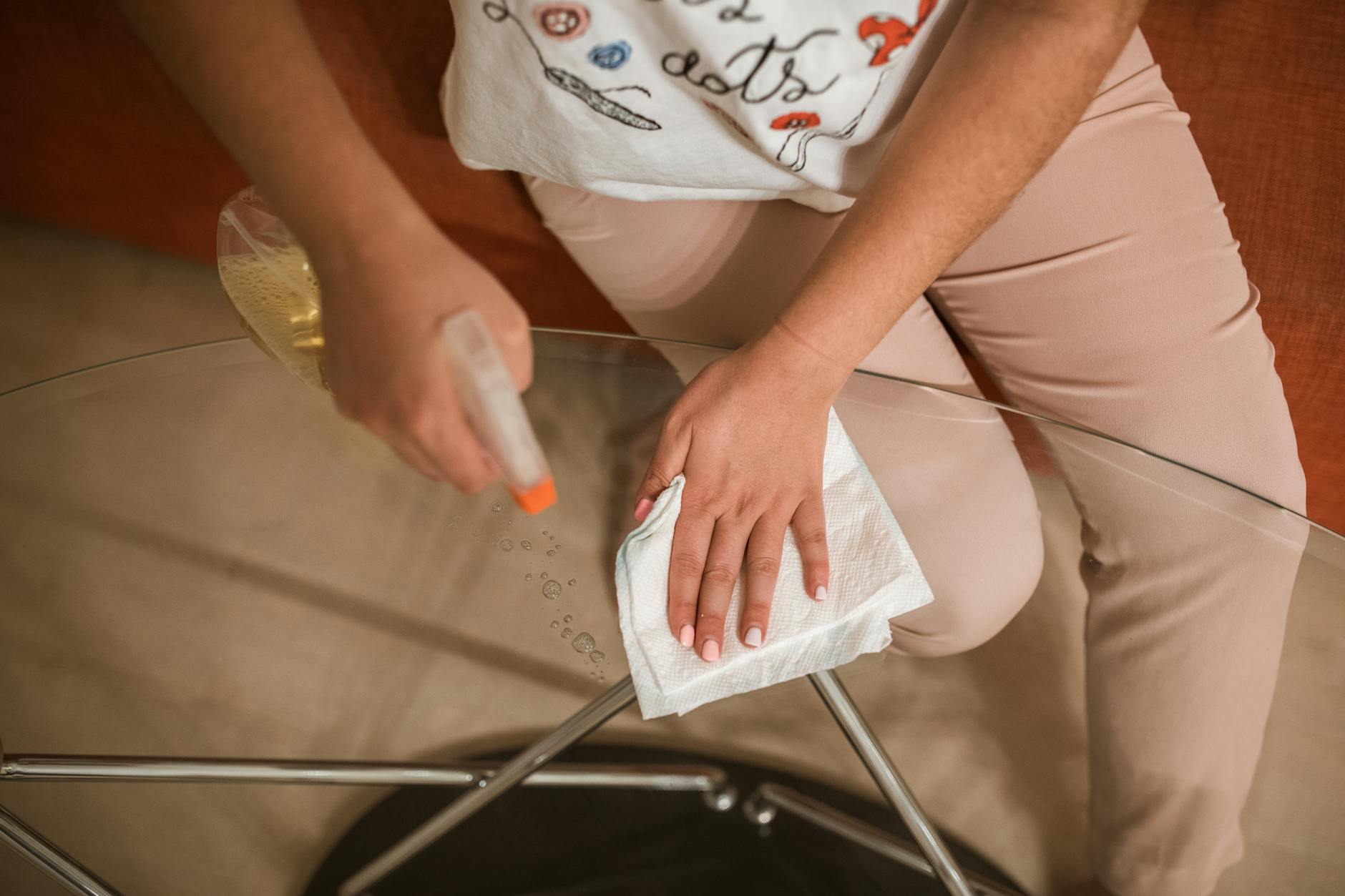
8 Cleaning Mistakes Experts Say Are Making Your Home Dirtier
SHARE:
The most common cleaning mistakes that make your home dirtier include using too much product, wiping surfaces with a dirty cloth, and confusing cleaning with disinfecting. These habits feel productive but they spread bacteria, leave residue, and grind grime deeper into surfaces. This post walks through eight specific errors and how to fix each one.
1. Using Too Much Cleaning Product
More product does not mean more clean. This is one of the most widespread cleaning mistakes homeowners make, and it backfires in a predictable way. When you overload a surface with spray cleaner, dish soap, or floor solution, the excess product does not rinse away cleanly. It sits on the surface and attracts dust, pet hair, and grime like a magnet.
Over time, surfaces treated with too much cleaner develop a sticky, dull film. Countertops look smeared even after you wipe them. Floors feel tacky an hour after mopping. Shower tiles look cloudy despite regular scrubbing. The culprit is almost always product buildup, not a lack of effort.
According to Good Housekeeping, most spray cleaners are formulated to work with a light, even coat. A two-second spray across a standard countertop is usually enough. For floors, follow the dilution ratio on the label rather than free-pouring into your mop bucket. Using concentrated cleaning solution at the wrong strength is one of the fastest ways to leave your home looking worse than before you started.
The fix is simple: use less, wipe thoroughly, and buff dry when needed. If you notice residue, a second pass with a clean, damp cloth will strip it away without adding more product.
2. Using One Cloth for Every Cleaning Job
One dirty cloth dragged across your whole house is not cleaning. It is relocating bacteria from one surface to another. This mistake is so common that professional cleaners consider it one of the top ways homeowners unknowingly spread germs around their homes.
Think about the route a single cloth travels during a typical cleaning session: toilet exterior, sink faucet, bathroom counter, kitchen counter, dining table. Each surface it touches after the first is now contaminated with whatever it picked up earlier. Using the same cloth for every cleaning job transfers fecal-oral pathogens from bathroom surfaces to food-prep areas, which is a genuine hygiene risk.
The professional standard is to use a color-coded microfiber system. Assign one color to bathrooms, a different color to kitchens, and another to general living areas. Wash cloths after every use in hot water. If you do not want to invest in a full microfiber set, at minimum keep bathroom cloths completely separate from kitchen cloths and never mix them.
A single-cloth cleaning habit also means you are wiping soiled surfaces with a rag that is already saturated with grime. A dirty cloth cannot absorb more dirt. It can only push it around. Swap cloths frequently during any cleaning session, even when you are working within the same room.
3. Ignoring Soap Residue on Surfaces
Soap residue is one of the sneakiest cleaning mistakes because it looks invisible at first. But left on countertops, shower walls, sinks, and stovetops, dried soap residue creates a film that collects grease, dust, and mineral deposits faster than a clean surface would.
The problem shows up most in bathrooms and kitchens. Bar soap scum on shower walls bonds with hard water minerals and calcium to form a crust that gets harder to remove the longer it sits. On kitchen counters, dish soap or all-purpose cleaner that is not fully rinsed away leaves a streaky haze that feels clean to the touch but looks dirty in natural light.
For bathroom surfaces and fixtures, use a squeegee after each shower to remove soap and water before residue can dry. For countertops, follow any cleaner with a wipe-down using a damp cloth with plain water, then buff dry with a dry cloth. For stovetops, check out our guide on kitchen deep cleaning in San Tan Valley for a room-by-room rinse routine that eliminates buildup for good.
Ignoring soap residue also affects grout lines. Soap film works into porous grout and creates a yellowed, dingy appearance that scrubbing alone cannot fix. A proper rinse step after every clean is the only way to prevent it from accumulating.
4. Cleaning with a Dry Cloth Instead of a Damp One
Wiping surfaces with a dry cloth is one of those cleaning habits that feels right but does the opposite of what you want. A dry cloth does not capture dust. It sends it airborne, where it floats for several minutes before settling back onto every surface you just wiped.
This is especially problematic on wood furniture, shelving, and electronics. Dry-cloth dusting with a dry rag or a used paper towel pushes particles off the surface without trapping them. If you are sneezing while you clean, this is likely why.
A slightly damp microfiber cloth is the right tool for almost every hard surface. The moisture helps the fibers trap particles instead of scattering them. For wood furniture, wring the cloth so it is barely damp, not wet. For electronics and screens, use a dry microfiber specifically designed for that purpose, but finish with a light pass to pick up what the dry wipe displaced.
The EPA’s guidance on indoor air quality notes that airborne particles are a significant contributor to poor indoor air. Dry dusting that suspends particles repeatedly throughout the week makes indoor air quality measurably worse, especially for households with allergy sufferers or children. Switching to damp-cloth cleaning is one of the simplest ways to reduce airborne particulates in your home.
5. Using a Blunt or Wrong Tool for Tight Spaces
Tight spaces collect a disproportionate share of a home’s dirt and grime, and the wrong cleaning tool for tight spaces will either skip over buildup entirely or push it deeper in. Using a blunt tool for narrow gaps and edges is one of the cleaning mistakes that pros flag most often when they walk into a home that gets cleaned regularly but never feels truly clean.
The problem areas are consistent: grout lines between tiles, the seal around faucets, the track of sliding doors and windows, the gap between the stove and the counter, the edges of baseboards, and the tight corners of showers. A standard sponge or flat mop cannot reach any of these areas effectively. A blunt tool pressed into a tight corner smears dirt rather than lifting it.
Effective tools for tight spaces include: an old toothbrush or a grout brush for tile lines and fixture seals, a flat-head screwdriver wrapped in a damp cloth for door tracks, a detail-tip vacuum attachment for window sills and baseboards, and a flexible crevice brush for the stove-counter gap. For bathroom tile and grout specifically, check out our bathroom cleaning tips for Scottsdale homeowners for targeted tool recommendations.
Having the right tool available matters less than actually using it. Build a five-minute tight-space routine into your cleaning schedule once a week and those areas will never reach the point where they require serious scrubbing to recover.
6. Reusing Dirty Mop Water
Reusing dirty mop water is the floor-cleaning equivalent of washing your dishes in the dishwater left over from last night’s pots. By the second pass across a room, your mop water is a murky soup of dissolved dirt, cleaning product residue, and bacteria. Every stroke after that point is depositing that mixture back onto your floors rather than lifting grime away.
Floors mopped with dirty water dry to a dull, grimy finish. The smell lingers. High-traffic areas like hallways and kitchen entries look worse after mopping than they did before. This is the reused dirty mop water problem, and it is one of the most common reasons mopped floors feel and look unclean even right after a session.
The solution is to change your mop water more often than feels necessary. For a standard home, start with two buckets of water: one with your diluted cleaning solution, one with plain rinse water. Wring into the clean solution bucket, mop a section, then rinse the mop head in the rinse bucket before repeating. Change both buckets when the rinse water turns visibly cloudy.
If you use a spin mop with a single bucket, empty and refill it at the halfway point of any floor larger than a standard bathroom. Microfiber mop heads that are pre-dampened rather than bucket-dipped avoid the dirty-water problem entirely and are worth the switch for most households.
7. Thinking That Cleaning and Disinfecting Are the Same Thing
Cleaning and disinfecting are two different processes, and confusing cleaning with disinfecting leaves your home sanitized in appearance only. This is one of the cleaning mistakes that matters most from a health standpoint, especially in households with young children, elderly family members, or anyone with a compromised immune system.
Cleaning removes visible dirt, grease, and grime from surfaces. It reduces the number of germs present but does not kill them. Disinfecting uses chemicals that kill bacteria and viruses on contact, but it only works effectively on a surface that has already been cleaned. Applying a disinfectant to a greasy stovetop or a dusty countertop without cleaning first significantly reduces the disinfectant’s ability to kill pathogens because organic matter blocks contact with the surface.
The correct sequence is always: clean first, then disinfect. For high-touch surfaces like door handles, light switches, toilet flush levers, and faucet handles, a dedicated disinfection service goes beyond what a standard wipe-down delivers. The EPA’s Safer Choice program lists disinfectants that are effective against common household pathogens while being safer for families and pets, which is a useful reference when choosing products.
During cold and flu season or after illness in the home, the clean-then-disinfect sequence on all high-contact surfaces should be non-negotiable. It is also the standard professionals use during any thorough deep clean.
8. Mixing Cleaning Products
Mixing cleaning products is not just ineffective. In some combinations it is genuinely dangerous. This is the cleaning mistake that surprises most people because the logic of combining two powerful cleaners to make something stronger feels intuitive. It is wrong, and in certain cases it can produce toxic fumes.
The most common dangerous combination is bleach and ammonia, which produces chloramine gas. Bleach and vinegar produce chlorine gas. Hydrogen peroxide mixed with vinegar creates peracetic acid, which is corrosive to skin and airways. These are not theoretical risks. They are real chemical reactions that happen in enclosed spaces like bathrooms with poor ventilation.
Beyond the safety hazard, mixing cleaning products often neutralizes both. Bleach mixed with an acid-based cleaner like vinegar renders the bleach ineffective before the mixture ever touches a surface. You are doing more work, spending more product, and getting less clean.
The EPA’s research on volatile organic compounds and indoor air quality highlights that cleaning products used improperly are a significant source of indoor VOCs, and mixing products amplifies that risk. Use one product at a time. Rinse surfaces between different products if you need to switch. Keep bleach-based products in a completely separate storage area from acid-based cleaners.
If you are planning a thorough seasonal clean and want a professional team that knows exactly which products to use safely and in what order, our holiday cleaning service covers every room with professional-grade products used correctly. For Arizona homeowners doing their own spring reset, the spring cleaning service in Chandler is another resource worth bookmarking.
Bonus: Neglecting the Garbage Disposal and Dishwasher
Two appliances that homeowners almost universally forget to clean are the garbage disposal and the dishwasher. Both get used daily to process food waste, and both can become significant odor sources if ignored.
For the garbage disposal, grinding ice cubes weekly breaks up grease and debris on the blades. Following that with a halved lemon eliminates odor. A baking soda and vinegar flush monthly keeps the drain line clear. For the dishwasher, pull the filter out monthly, rinse it under hot water, and run an empty cycle with a cup of white vinegar on the top rack. These two steps take less than ten minutes combined and prevent two of the most stubborn household odors.
Bonus: Rubbing a Carpet Stain Instead of Blotting It
Rubbing a carpet stain is the fastest way to make it permanent. The friction pushes the staining agent deeper into the carpet fibers and spreads it laterally, turning a small spot into a larger one. It also damages the fiber structure of the carpet, creating a fuzzy, matted area that catches future dirt even after the stain is gone.
The correct method is to blot from the outside edge of the stain inward using a clean, dry white cloth. Apply light pressure and lift. Repeat with a fresh section of cloth until no more color transfers. Then apply your cleaning solution, let it dwell briefly, and blot again. Never scrub. Patience and a clean cloth are more effective than effort and elbow grease here.
Working with a Arizona cleaning company like Elite Maids means you get a team that avoids every single one of these mistakes on every visit. Our cleaners use color-coded microfiber systems, proper dilution ratios, and the correct tools for every surface and tight space in your home. If you want your home genuinely clean rather than just rearranged, professional cleaning makes the difference.
Frequently Asked Questions
What are the most common cleaning mistakes people make at home?
The most common cleaning mistakes are using too much product (which leaves sticky residue), using one cloth across every surface (which spreads bacteria), confusing cleaning with disinfecting, and mopping with dirty water. Each of these habits makes surfaces dirtier over time rather than cleaner, even when effort and frequency are high.
Does using more cleaning product mean a surface gets cleaner?
No. Using too much cleaning product leaves a residue film on surfaces that attracts dust and grime faster than a clean surface would. Most cleaners are formulated to work with a light application. More product means more buildup, not a better result. Follow label dilution instructions and wipe with a damp cloth to remove any excess.
Is it safe to mix bleach and vinegar when cleaning?
No. Mixing bleach and vinegar produces chlorine gas, which is a respiratory irritant and potentially dangerous in enclosed spaces with poor ventilation. Never mix different cleaning products. Use one product at a time, rinse the surface between products if needed, and store bleach-based cleaners separately from acid-based ones like vinegar.
What is the difference between cleaning and disinfecting?
Cleaning removes visible dirt and reduces the number of germs on a surface. Disinfecting kills bacteria and viruses using chemicals, but it only works effectively on an already-cleaned surface. The correct sequence is always clean first, then disinfect. Applying a disinfectant to a dirty surface significantly reduces how well it kills pathogens.
How often should I change my mop water?
Change your mop water at least once per room, or whenever the water becomes visibly cloudy. For larger open-plan spaces, change it at the halfway point. Using two buckets, one with cleaning solution and one for rinsing, extends how long your water stays effective. Dirty mop water spreads grime rather than removing it.
Ready to stop the cycle of cleaning mistakes that leave your home looking less clean than it should? Contact Elite Maids house cleaning today for a free quote and let Arizona’s most-reviewed residential cleaning team handle it right, every time.